

Choosing men’s leather bracelets Australia wide comes down to three factors: leather cut, clasp security, and wrist circumference. The most versatile option for most Australian men is a 6 mm braided bolo cord bracelet with a 316L stainless steel magnetic locking clasp in matte black or brushed steel.
Men’s leather bracelets in Australia are wrist-worn accessories crafted from cowhide or calfskin strips, cords, or bands, fastened with stainless steel or brass clasps. They range from formal braided cords to casual raw cuffs, sized by adding 0.6 to 2.5 centimetres to bare wrist circumference for fit.
In Short
- Average wrist baseline: The average Australian male wrist measures 18 cm (7 inches), requiring a 19.5 cm bracelet for a standard fit.
- Core styles: Braided leather offers the greatest versatility, cuffs deliver a rugged aesthetic, wraps provide relaxed layering, and beaded-leather hybrids add mineral texture.
- Hardware priority: Insist on grade 316L surgical stainless steel clasps with mechanical bayonet or interlocking magnetic pins to resist corrosion from humidity and salt air.
- Fit allowances: Add 0.6–1.2 cm for a tight fit, 1.3–1.9 cm for a standard fit, and 2.0–2.5 cm for a loose fit.
- Water rule: Never submerge leather bracelets in the ocean, freshwater pools, or showers, as chlorinated water and salt wash out tanning oils and stiffen the hide.
The 4 Core Styles of Men’s Leather Bracelets in Australia
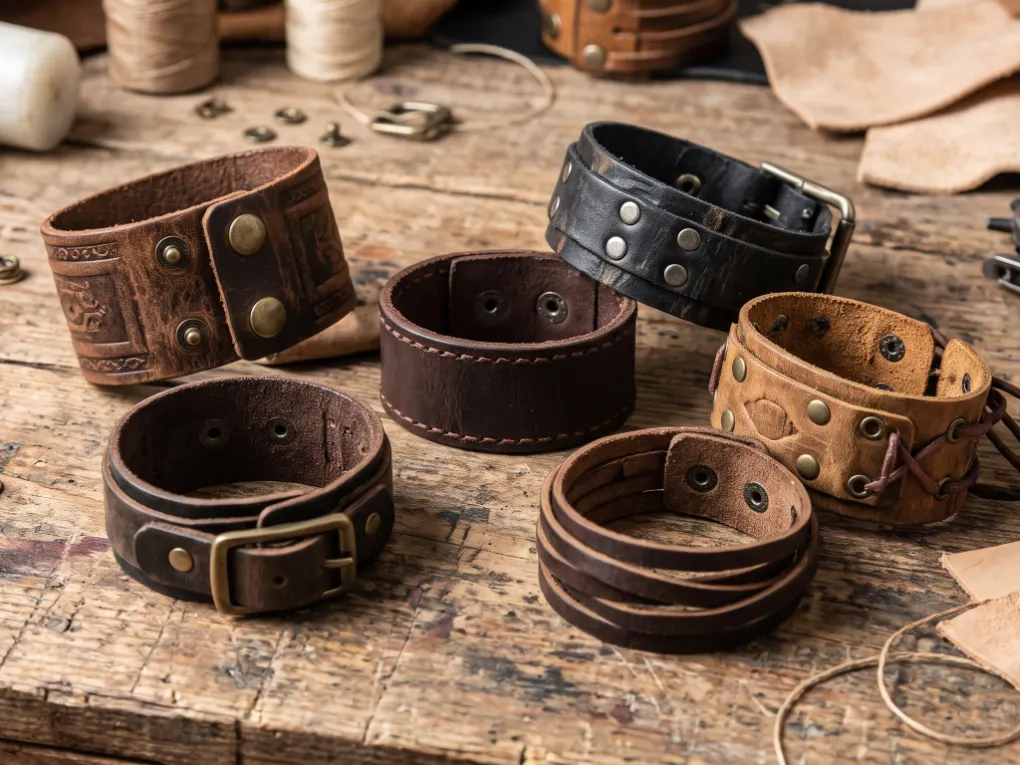
Leather wristwear falls into four distinct structural categories. Each style alters your silhouette differently, behaves uniquely under shirt cuffs, and requires a specific thickness of hide to maintain its shape over years of daily wear. When comparing a braided vs cuff leather bracelet, your choice determines whether the piece wears like a discreet accent or a bold statement piece.
Braided Leather Bracelets
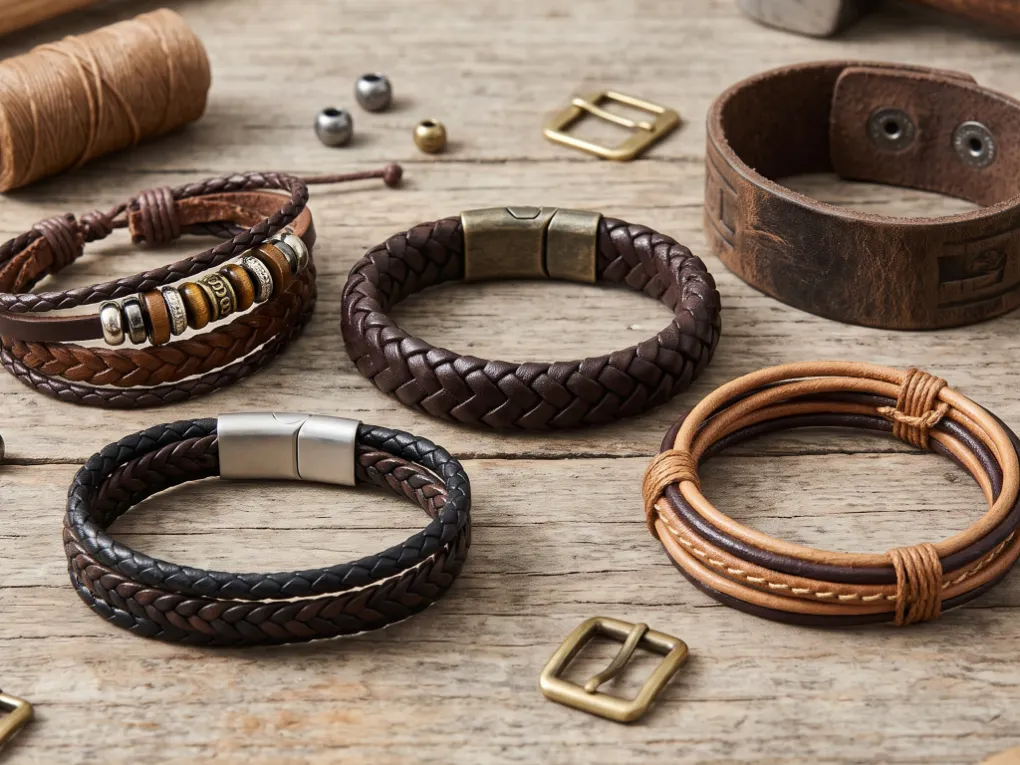
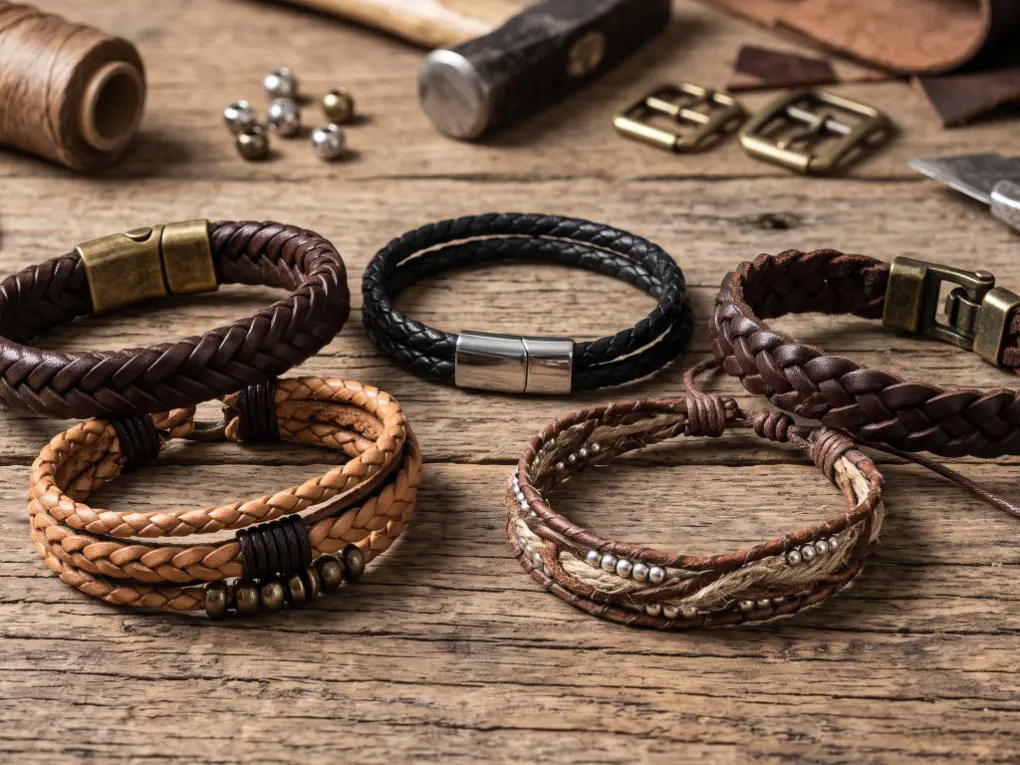
Braided bracelets represent the standard in contemporary men’s wrist accessories. Manufacturers construct these using tightly plaited cords—typically four, six, or eight strands of vegetable-tanned top-grain calfskin or cowhide braided around a central core.
A 6 mm diameter round braid sits comfortably under standard buttoned shirt cuffs without snagging the fabric. Flat plaits measure between 8 mm and 12 mm across, offering greater wrist coverage while lying flush against the skin. Because braiding distributes tension across multiple strands, braided bands flex easily around the wrist bone. However, moisture can collect within the valleys of the plait, making regular cleaning necessary in hot, humid climates.
Leather Cuff Bracelets
Cuffs are cut from single, wide strips of vegetable-tanned cowhide ranging from 15 mm to over 40 mm in width. Leather thickness generally ranges between 2.5 mm and 3.5 mm (approximately 6 to 9 oz leather weight) to prevent the band from collapsing or rolling at the edges.
A leather cuff acts as a standalone visual anchor on the forearm. Traditional designs secure with dual button studs or twin buckle straps, while minimalist modern versions mount directly to an internal malleable aluminium or brass spring-core that moulds to the contour of your wrist. While durable, solid cuffs trap body heat against the skin during hot summer months and will not slide beneath tailored dress shirts.
Wrap Bracelets
Wrap bracelets use a single continuous leather lace, measuring between 40 cm and 90 cm in length, that winds around the wrist two, three, or four times. The leather cord itself is kept thin—typically 3 mm to 5 mm wide and 1.5 mm thick—to keep the stacked profile from becoming overly bulky.
Wraps allow you to adjust how tightly each turn rests against your arm. They often secure using a metal button or anchor charm threaded through a knotted terminal loop. Owners report that multi-wraps require more care during daily fastening, but they provide an effortless, layered look without the need to buy and coordinate multiple individual bracelets.
Beaded Bracelets with Leather Accents
This hybrid design combines natural stone beads—such as 6 mm or 8 mm matte black onyx, volcanic lava stone, or tiger’s eye—with braided or smooth leather strands running parallel or woven through the centre.
The primary advantage is structural variety: polished minerals contrast against the warm, organic texture of the hide. In quality pieces, the beads are strung on stainless steel wire or heavy-duty synthetic cord terminated directly into the leather end-caps, rather than weak elastic thread that degrades when exposed to sweat.
| Style | Width Profile | Flexibility | Formal Rating (/10) | Summer Sweat Resistance |
| Round Braided | 4 mm – 8 mm | High | 8/10 | Moderate |
| Flat Cuff | 15 mm – 40 mm | Low | 3/10 | Low |
| Multi-Wrap | 3 mm – 5 mm cord | High | 5/10 | Moderate |
| Beaded Hybrid | 6 mm – 10 mm | Moderate | 6/10 | Moderate |
How to Measure Your Wrist for Accurate Sizing
A leather bracelet that fits incorrectly will either constrict circulation or slide constantly along your forearm, catching on desk edges and scratching your watch case. Unlike stainless steel link bracelets, leather bands cannot be shortened by tapping out links. You must get the measurement right before buying.
For an extensive step-by-step breakdown across all wrist profiles, consult our dedicated leather bracelet size guide wrist reference.
Step-by-Step Measurement Procedure
- Locate your wrist bone: Position your hand palm up and locate the prominent bony bump on the outside of your wrist (the styloid process of the ulna).
- Wrap your measurement tool: Take a flexible tailor’s tape measure and wrap it snugly around your wrist immediately above the bone (towards your elbow), or directly over the spot where you intend to wear the bracelet.
- Record bare circumference: Pull the tape flat against the skin without compressing the flesh. Note the exact figure in centimetres. If you lack a tailor’s tape, wrap a non-stretching strip of paper or cord around the wrist, mark the overlap with a fine pencil, and lay it flat against a rigid ruler.
Sizing Tolerances and Fit Allowances
According to sizing data from Australian jewellery retailer Shiels AU and men’s accessory specialist Trendhim AU, the average Australian male wrist measures 18 cm (approximately 7 inches).
Never purchase a bracelet sized to your bare wrist measurement. Because leather has physical thickness, the inner circumference of a closed bracelet is significantly smaller than its exterior length. You must add an allowance based on your preferred fit style:
- Tight fit (Snug): Add +0.6 cm to +1.2 cm to your bare measurement. The bracelet stays firmly in place without sliding, which prevents a companion watch from colliding with it.
- Normal fit (Standard): Add +1.3 cm to +1.9 cm to your bare measurement. The band moves comfortably by 1 to 2 cm up and down the wrist. This is the recommended choice for everyday comfort.
- Loose fit (Relaxed): Add +2.0 cm to +2.5 cm to your bare measurement. The piece drapes across the base of the hand. This fit suits wide cuffs or multi-wrap designs.
The Width Compensation Rule
Wide cuffs and heavy 10 mm braided ropes demand an extra 0.5 cm over thin 4 mm bands. A thick piece of leather eats into the internal radius when curled into a circle. If your bare wrist is 18 cm and you order a 19.5 cm cuff cut from 3.5 mm saddle hide, it will fit tighter than a 19.5 cm slender braided cord.
How to Style a Leather Bracelet with a Watch
Wearing a bracelet alongside a wristwatch is a reliable way to add personality to your wristwear, but poor execution leads to scratched cases and visual clutter. For an exhaustive visual walkthrough, see our tutorial on how to style leather bracelet with watch.
Wrist Placement: Same Arm vs Opposite Arm
You have two structural options when styling:
- The Shared Wrist (Stacked): Placing the bracelet on your watch wrist creates a cohesive visual cluster. Always position the leather bracelet above the watch (closer to the elbow, behind the case). This prevents the bracelet from slipping down over your hand, keeps your watch face unobstructed, and prevents the clasp from striking the watch crown. Stick to a single thin braided cord (4 mm to 6 mm) to preserve balance.
- The Counterbalance (Opposite Wrist): Wearing your watch on one wrist and your bracelet on the other distributes weight evenly across your arms. This configuration allows you to wear wider cuffs (15 mm to 25 mm) or multi-layered wraps without visually overpowering your timepiece.
Leather Colour Alignment
Harmonise the colour of your bracelet with your other daily leather goods. The traditional styling standard requires matching your leathers:
- Black Leather: Pair a black braided bracelet with black watch straps, black boots, and a black belt. Black works best alongside monochromatic, modern, or minimalist wardrobes.
- Brown and Tan Leather: Pair rich chestnut, dark chocolate, or caramel leather bands with warm-toned watch straps, brown dress shoes, and raw selvedge denim. Because natural vegetable-tanned leather patinas over time, slight variations in brown tones look organic rather than mismatched.
Hardware and Metal Coordination
Never ignore the metal hardware. The clasp of your leather bracelet must coordinate with the metal finish of your watch case:
- If your watch is polished 316L stainless steel, choose a bracelet with a polished or brushed silver-tone steel clasp.
- If your watch case is bronze, yellow gold, or rose gold, select brass, bronze-PVD, or matching warm-toned gold hardware.
- Black PVD-coated clasps are neutral: they blend seamlessly with black tactical watch cases, carbon fibre dials, and gunmetal finishes.
Proportional Balance
Match the scale of the bracelet to the diameter and thickness of your watch. A 38 mm vintage dress watch looks dwarfed next to a 30 mm raw leather cuff; it pairs naturally with a discreet 4 mm black braided band. Conversely, a substantial 44 mm dive watch or pilot chronograph demands a 6 mm to 8 mm braided band or a dual-wrap cord to maintain balanced visual proportions.
Leather Care for Bracelets in Australian Conditions
Australia’s climate presents specific challenges for natural leather. Scorching summer temperatures, high relative humidity in Queensland and coastal New South Wales, and high UV radiation across the continent break down tanning emulsions, dry out hide fibres, and cause leather to crack or sour if neglected.
To understand maintenance fundamentals across your entire collection, read our guide to leather care for accessories.
Sweat and Salt Management
Perspiration contains salt, urea, and fatty acids. When absorbed by untreated leather, sweat draws out moisture as it evaporates, leaving rigid salt crystals inside the collagen matrix. Over months, this makes the leather stiff, brittle, and prone to splitting under tension.
At the end of a warm day, remove your bracelet and wipe the inner surface with a clean, dry microfibre cloth. This simple two-second habit clears moisture and skin oils before they soak deeply into the leather core.
Water Exposure: Swimming and Showers
Water is the primary enemy of vegetable-tanned and chrome-tanned jewellery.
- Showers: Hot water, soap surfactants, and shampoo wash away protective waxes and preservative tanning agents. Always take your bracelet off before stepping into the shower.
- Saltwater and Surf: Ocean water saturates the core with marine salts that corrode internal glue lines and rust cheap internal clasp springs.
- Chlorinated Pools: Chlorine oxidises tanning chemicals, strips surface finishes, and causes pale leathers to turn chalky and discoloured.
If your bracelet gets wet accidentally, pat it dry immediately with an absorbent cotton towel. Allow it to air-dry naturally at room temperature away from direct sunlight, radiant heaters, or hair dryers. Forcing leather to dry quickly under high heat shrinks the collagen fibres and causes the hide to warp.
The Conditioning Protocol
Condition your leather bracelet once every three to four months:
- Clean: Lightly moisten a cloth with clean water and a tiny dab of pH-neutral saddle soap. Wipe the surface to loosen grime, then dry thoroughly.
- Treat: Apply a pea-sized amount of beeswax-based leather cream or natural conditioner (such as dubbin or neat’s-foot oil blends) using your fingertips. Avoid heavily liquid oils, which can over-saturate and soften braided cords, causing them to stretch under tension.
- Buff: Allow the balm to penetrate for 15 minutes, then buff the exterior briskly with a dry microfibre rag to remove excess residue and restore a low-sheen satin luster.
What to Look for When Buying Men’s Leather Bracelets in Australia
Navigating men’s leather accessories online requires knowing how to separate durable craftsmanship from cheap, bonded-leather throwaways that disintegrate within months.
Clasp Engineering and Material Integrity
The clasp is the most common mechanical failure point on any men’s bracelet. Avoid base metals like zinc alloy or nickel-plated pot metals, which pit and corrode when exposed to sweat.
- 316L Surgical Stainless Steel: This is the benchmark material for wristwear hardware. It resists sweat corrosion, will not tarnish, and is hypoallergenic for men sensitive to nickel.
- Magnetic Bayonet Clasps: High-grade designs use an internal neodymium magnet paired with a mechanical twist-and-lock bayonet pin. The magnet guides the two ends together, while the steel pin bears the physical tension. Avoid clasps that rely solely on flat magnetic attraction without a mechanical interlock, as they pull apart when catching on jacket cuffs.
- Shackle and Screw Pins: Nautical-style bow shackles made of marine-grade brass or stainless steel provide maximum security, though they take longer to screw on with one hand.
Leather Grades: Avoiding Bonded Traps
- Full-Grain Leather: The top layer of the hide with the natural grain left intact. It possesses the tightest fibre structure, resists surface abrasions, and develops an attractive patina over years of wear.
- Top-Grain Leather: The surface layer is gently buffed to remove blemishes, resulting in a uniform, supple finish that braids cleanly without flaking.
- Bonded / “Genuine” Leather: Beware of products labelled vaguely as “Genuine Leather” selling for under $20. These are frequently bonded leather—shredded leather scraps blended with polyurethane binders and stamped with an artificial grain. In Australia’s summer heat, bonded leather delaminates, cracks, and releases adhesive odours within weeks.
Australian Retailers and Price Expectations
When buying locally, check return policies and confirm whether the vendor provides explicit millimetre sizing.
- Department Stores and Jewellers (e.g., Shiels AU, Myer): Offer commercial stainless steel and leather pieces. For example, the Forte Stainless Steel Black Leather Bracelet retails at Shiels AU for AUD $49.99 (discounted from AUD $99.99). Price checked: 8 November 2026.
- Dedicated Men’s Specialists (e.g., Trendhim AU): Provide extensive Scandinavian-designed collections with precise wrist sizing charts. Standard braided cords from brands like Lucleon range between AUD $45.00 and AUD $85.00 at Trendhim AU. Price checked: 8 November 2026.
- Bespoke Australian Leather Crafters: Local saddlers and artisans charge between AUD $90.00 and AUD $180.00 for custom-sized, hand-stitched Australian bovine or kangaroo leather cuffs. Kangaroo hide offers exceptional tensile strength at thinner cuts, making it an outstanding local alternative.
To see our current ranked product recommendations across every budget tier, check out our guide to the best leather bracelets for men Australia.
| Material / Component | Acceptable Standard | Premium Standard | Avoid / Dealbreaker |
| Leather Grade | Top-grain bovine leather | Full-grain vegetable-tanned hide | Bonded, PU, or “bicast” leather |
| Hardware Metal | 304 Stainless steel | 316L Surgical steel or solid brass | Zinc alloy, nickel-plated pot metal |
| Locking Mechanism | Friction-lock hook | Bayonet twist + neodymium magnet | Friction slide without lock pin |
| Origin / Tannage | Certified chrome-tanned | Pit-tanned European / Australian | Unlabelled synthetic blends |
Who This Is For and Who Should Skip It
Who This Is For
- Men who want a low-profile wrist accent: A 6 mm braided leather band provides subtle texture that complements casual tailoring, t-shirts, and everyday business shirts.
- Watch wearers looking to balance their wrists: A leather bracelet offers an organic counterbalance on your opposite arm, breaking up metal-heavy jewellery.
- Men who value durable goods that patina: Quality vegetable-tanned leather moulds to the shape of your wrist over time, developing a unique character reflecting your lifestyle.
Who Should Skip It
- Daily swimmers and surfers: If you spend your mornings in the ocean or pool laps, a leather band will rot quickly. Opt for a 316L stainless steel chain, titanium cuff, or marine-grade paracord bracelet instead.
- Manual trade workers on active job sites: Tradesmen working around spinning power tools, machinery, or heavy construction should skip wrist cords entirely due to snagging hazards.
- Men who want zero-maintenance accessories: If you refuse to take off your wristwear before showering or dislike conditioning natural hide, opt for solid metal or silicone.
Frequently Asked Questions About Men’s Leather Bracelets in Australia
Can I wear my leather bracelet in the shower or ocean?
No, you should never wear a leather bracelet while showering or swimming in the ocean. Water, body soaps, and sea salts strip the natural preserving oils from the leather, causing the hide to shrink, warp, and crack as it dries. Salt residue also corrodes internal metal clasp pins.
What is the average men’s bracelet size in Australia?
The average Australian male wrist circumference is 18 cm (7 inches), requiring a bracelet length of 19.3 cm to 19.9 cm for a standard, comfortable fit. Men with slender wrists typically measure 16.5 cm, while larger wrists measure 20 cm or more.
How tight should a men’s leather bracelet be?
A men’s leather bracelet should fit comfortably enough to allow one finger to slide smoothly between the band and your skin. It should move slightly along your forearm as your arm shifts, without hanging down over your palm or binding tightly against your wrist bone.
Does kangaroo leather make good bracelets?
Yes, vegetable-tanned Australian kangaroo leather is one of the strongest leathers in the world for its thickness. Its dense, interlocking collagen fibres give it extraordinary tensile strength, allowing artisans to craft thinner, lighter braided bracelets that resist stretching better than traditional cowhide.
Which wrist should a man wear a leather bracelet on?
There are no rigid rules, but most men wear a leather bracelet on their non-dominant wrist, or on the wrist opposite their wristwatch to balance their appearance. If worn on the same wrist as your watch, place the bracelet above the watch case to prevent the clasp from scratching the case finish.
Conclusion
Choosing quality men’s leather bracelets Australia wide comes down to measuring your bare wrist accurately, selecting 316L surgical stainless steel clasps, and choosing full-grain or top-grain leather that can withstand our local climate.
Begin by checking your exact wrist circumference against our leather bracelet size guide wrist, compare structural trade-offs in our braided vs cuff leather bracelet head-to-head, or explore our top-rated market picks in our guide to the best leather bracelets for men Australia.
