
Navigating the showroom floor is exciting, but securing the money to pay for the vehicle is where real financial decisions happen. Walking into a dealership without a solid auto finance strategy often means paying thousands of dollars in unnecessary interest, dealer markups, and hidden fees.
This car financing guide covers every step of the borrowing process. Whether evaluating your first vehicle, comparing bank pre-approvals against dealer offers, or researching regional guidelines such as a car loan guide Malaysia context versus US credit tier structures, this breakdown ensures you sign a contract that protects your long-term wealth.
What Is Car Financing and How Does It Work?
To understand what is car financing, consider it a three-way agreement between you, a vehicle seller, and a financial lender. Unless you pay the total purchase price upfront in cash, you borrow funds from a financial institution (a bank, credit union, or captive dealer finance company) to buy the vehicle.
The lender pays the dealer or private seller for the car. In exchange, you agree to repay the lender the principal balance plus interest across a predetermined schedule of monthly payments.
+------------------------------------------------------------------+
|                     HOW CAR FINANCING WORKS                      |
|                                                                  |
|   1. Down Payment + Trade-In Cash Value                          |
|   2. Lender Covers Remaining Vehicle Balance (Principal)         |
|   3. You Repay Lender: Principal + APR over 24-84 Months         |
|   4. Lender Holds Vehicle Title / Lien Until Debt is Cleared     |
|   5. Title Released -> You Own the Car Free and Clear            |
+------------------------------------------------------------------+
Key Auto Finance Terminology Every Buyer Must Know
- Principal: The base amount borrowed after subtracting your down payment and trade-in value from the total out-the-door price.
- Annual Percentage Rate (APR): The total yearly cost of borrowing money, including both the base interest rate and any mandatory lender fees.
- Loan Term: The duration of the loan, usually expressed in 12-month increments (e.g., 36, 48, 60, or 72 months).
- Down Payment: Upfront cash paid at the time of purchase to reduce the total amount financed.
- Lien & Title: The legal document establishing vehicle ownership. When you finance, the lender places a lien on the vehicle title until the loan is paid in full.
- Amortization: The repayment schedule that details how each payment is divided between interest charges and principal reduction.
Direct Lending vs. Dealership Dealership Financing: Which Is Better?
When shopping for an auto loan, borrowers have two primary channels: direct lending and indirect dealership financing. Understanding the difference between these channels helps identify what is the best car financing for your specific credit profile.
| Feature | Direct Lending (Banks & Credit Unions) | Dealership Financing (Captive / In-House) |
| Loan Originator | Local credit unions, national banks, online lenders | Automaker finance arms (e.g., Ford Credit, Toyota Financial) or dealer broker networks |
| Interest Rates | Highly competitive base rates; non-negotiable fixed spreads | Promotional 0%–1.9% APR available on select new models; higher discretionary rate markups on used cars |
| Negotiation Power | Gives you cash-buyer leverage on dealer showroom floors | Dealer handles paperwork, but may bundle add-on fees into the monthly payment |
| Approval Flexibility | Credit unions offer leniency for local community members | Can finance subprime borrowers via broad multi-lender desk software |
| Best Suited For | Used car purchases, private party sales, members of credit unions | Brand-new car promotions with manufacturer rate subsidies |
Essential Car Financing Guidelines: The 20/4/10 Rule
A central pillar in any sound car buying financial guide is avoiding becoming “car poor.” Vehicle depreciation occurs immediately, so over-borrowing can lead to negative equity (owing more than the car is worth, commonly known as being “underwater”).
The gold standard framework recommended across financial communities, including practical threads on car loan guide reddit forums, is the 20/4/10 Rule:
- 20% Down Payment: Put down at least 20% of the vehicle’s out-the-door cost in cash or trade-in equity for a new car (10% minimum for a reliable used car). This insulates you against the initial steep depreciation drop.
- 4-Year Maximum Term (48 Months): Keep your loan repayment period to 48 months or fewer. This ensures you pay off the principal balance faster than the vehicle loses market value.
- 10% Monthly Income Cap: Your total monthly automotive expenses—including loan principal, interest, insurance premiums, fuel, and routine maintenance—should not exceed 10% of your gross monthly income.
Example: The 20/4/10 Rule in Action
Assume a gross income of $6,000 per month:
- Max Total Auto Budget (10%): $600/month across loan, gas, and insurance.
- Allocated Monthly Car Loan Payment: ~$380–$420/month.
- Max Loan Amount Over 48 Months at 6.0% APR: ~$17,500.
- Required 20% Down Payment: ~$4,375.
- Target Out-the-Door Vehicle Price: ~$21,875.

How Many Months Should You Finance a Car? (Loan Term Analysis)
One of the most frequent consumer questions is: how many months should you finance a car?
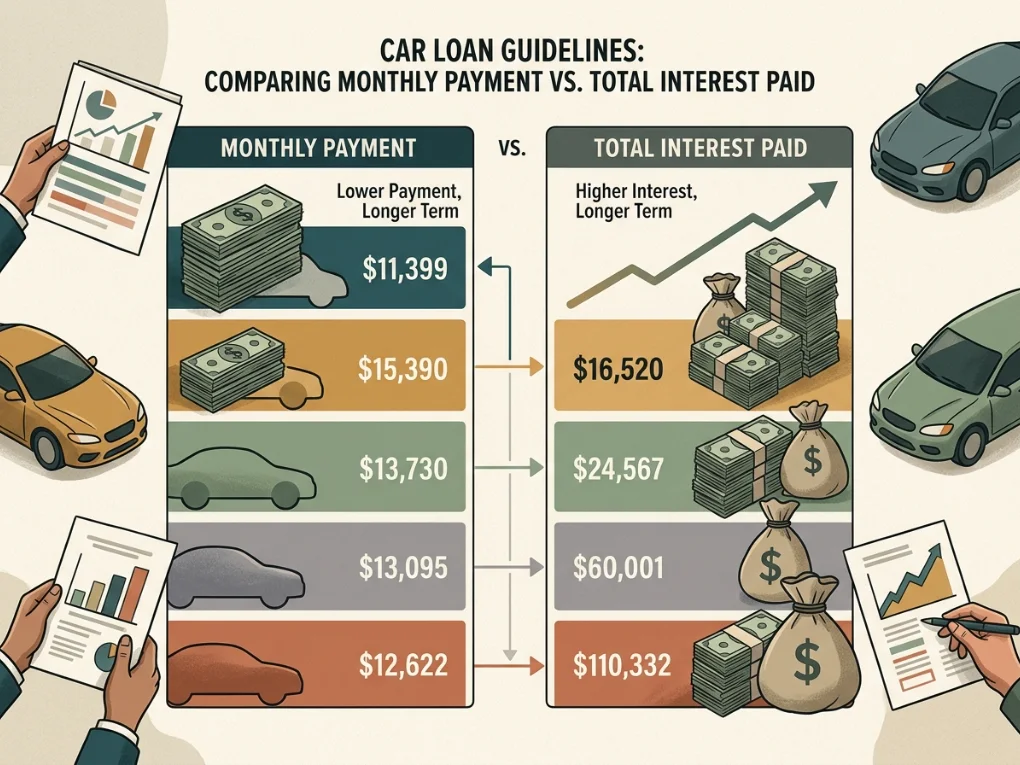
While lenders offer loans stretched out to 72, 84, or even 96 months to advertise lower monthly payments, long terms significantly increase the total cost of ownership.
TOTAL INTEREST COMPARISON ON A $30,000 AUTO LOAN AT 7.0% APR

36 Months | Payment: $926/mo  | Total Interest: $3,346  | Total Paid: $33,346
48 Months | Payment: $718/mo  | Total Interest: $4,484  | Total Paid: $34,484
60 Months | Payment: $594/mo  | Total Interest: $5,642  | Total Paid: $35,642
72 Months | Payment: $512/mo  | Total Interest: $6,835  | Total Paid: $36,835
84 Months | Payment: $453/mo  | Total Interest: $8,071  | Total Paid: $38,071
Why 36 to 48 Months Is the Financial Sweet Spot
- Accelerated Equity: You build equity quickly, allowing you to sell or trade the vehicle without paying out-of-pocket to clear negative balances.
- Lower APR Tiers: Lenders typically offer their lowest interest brackets for shorter loan terms because their capital risk exposure is minimized.
- Warranty Alignment: A 36- or 48-month loan ensures the vehicle remains under the factory bumper-to-bumper or powertrain warranty while you are paying it off, protecting you from simultaneous repair bills and loan installments.
The Dangers of 72- and 84-Month Auto Loans
- Prolonged Negative Equity: You remain underwater for 3 to 5 years. If the car is totaled or stolen, insurance will only pay market value, leaving a remaining balance unless you carry GAP insurance.
- Interest Waste: On an 84-month loan, you can end up paying over double the interest compared to a 48-month schedule for the exact same car.
Step-by-Step Car Loan Guide: From Pre-Approval to Driving Home
Applying for an auto loan requires a clear order of operations to retain bargaining power. Follow this systematic auto finance guide process before stepping into any dealership.
+-----------------------------------------------------------------------------+
|                      5-STEP AUTO LOAN PROCESS                               |
|                                                                             |
|  [Step 1] Check Credit Scores & Resolve Errors                              |
|       |                                                                     |
|  [Step 2] Determine Realistic Budget via 20/4/10 Rule                       |
|       |                                                                     |
|  [Step 3] Secure 2-3 Independent Pre-Approvals (Banks/Credit Unions)        |
|       |                                                                     |
|  [Step 4] Separate Vehicle Price Negotiation from Financing at Dealership   |
|       |                                                                     |
|  [Step 5] Review Contract: Avoid Junk Add-Ons & Finalize Signatures        |
+-----------------------------------------------------------------------------+
Step 1: Check Credit Scores and Fix Discrepancies
Your credit score determines the interest rate tier lenders offer:
- Super-Prime (781–850): Best rates, access to manufacturer promotional APRs (0%–3%).
- Prime (661–780): Competitive market interest rates from banks and credit unions.
- Non-Prime (601–660): Moderate rates; may require larger down payments.
- Subprime (501–600) & Deep Subprime (300–500): High interest rates (often 14%–20%+); requires strict proof of income and co-signers.
Pull your credit report from all three major bureaus (Equifax, Experian, TransUnion). Dispute inaccurate collections, late payments, or outstanding balances at least 60 days before applying for auto financing.
Step 2: Establish Your Total Budget
Calculate the “Out-the-Door” (OTD) price rather than negotiating based on monthly payments. The OTD price includes:
Dealers often use a tactic called “payment packing,” adjusting the loan term or adding warranties to hit a target monthly payment while quietly increasing the total purchase price. Always negotiate the total vehicle cost first.
Step 3: Secure Independent Pre-Approvals
Submit loan applications to 2 or 3 institutions (such as a local credit union and an online auto lender) within a 14-day window. Credit reporting models treat multiple auto loan inquiries made within a focused 14-to-45-day window as a single hard pull, protecting your credit score from compounding hits.
Having a written pre-approval letter establishes a baseline interest rate. If the dealer wants you to finance through their in-house network, they must beat your pre-approved rate.
Step 4: Negotiate Price and Financing Separately
Treat your car purchase as three distinct, isolated transactions:
- The Vehicle Purchase Price: Negotiate the vehicle cost based on invoice pricing, market comps, and dealer inventory levels.
- The Trade-In Value: Obtain written instant-cash offers from services like CarMax, Carvana, or local buyers before discussing trade-in values with the selling dealer.
- The Financing Terms: Introduce your pre-approval letter only after the vehicle price and trade-in value are locked down in writing.
Step 5: Scrutinize the Finance & Insurance (F&I) Box
Once you agree on price, you enter the Finance & Insurance office to sign contracts. The F&I manager may present a menu of optional dealer add-ons rolled into your monthly financing:
- Extended Service Contracts (Warranties): Often marked up 100%–200%. If desired, buy directly from the manufacturer or negotiate the price down.
- Guaranteed Asset Protection (GAP) Insurance: Essential if your down payment is less than 20%, but dealership policies ($800–$1,200) often cost 3x more than obtaining GAP coverage through your auto insurance provider ($20–$40/year).
- Tire & Wheel Protection, Paint Sealant, VIN Etching: Dealer-installed items that can almost always be declined to save money.
Global Perspectives: Understanding Car Loan Guidelines Across Markets
While core financial logic applies worldwide, specific regulatory frameworks and lending structures differ by country.
Car Loan Guidelines in the United States and Canada
- Simple Interest Contracts: Standard across North American auto loans. Interest accrues daily based on the remaining principal balance. Paying extra money toward the principal reduces total interest paid and shortens the loan term without penalty.
- Prepayment Penalties: Most consumer auto loans in the US prohibit prepayment penalties, but verify the fine print under the Truth in Lending Act (TILA) disclosures before signing.
Car Loan Guide Malaysia: Hire Purchase (HP) Regulations
Financing in Malaysia runs on distinct statutory car loan guidelines governed by the Hire Purchase Act 1967:
- Hire Purchase Concept: The bank remains the legal owner of the vehicle; you act as the “hirer” until the final installment is completed.
- Fixed-Rate Rule-of-78 Accounting: Many Malaysian vehicle loans calculate interest upfront on the full initial principal using a flat rate. Under the Rule of 78, interest charges are weighted heavily into the early years of the loan, which means early settlement yields fewer interest savings compared to standard reducing-balance loans.
- Margin of Financing: Bank Negara Malaysia (BNM) regulations typically cap financing at 90% of the vehicle’s agreed value, requiring a mandatory minimum 10% cash down payment.
- Maximum Loan Tenure: Maximum statutory repayment terms are capped at 9 years (108 months).
Car Finance Advertising Guidelines: Spotting Misleading Offers
Regulatory bodies like the US Federal Trade Commission (FTC) enforce strict car finance advertising guidelines to prevent deceptive dealer promotions. Knowing how to read these ads protects you from common showroom traps:
+--------------------------------------------------------------------------+
|                  COMMON DECEPTIVE AUTO FINANCE CLAIMS                    |
|                                                                          |
|  Ad Headline: "0% APR Financing Available on All New SUVs!"              |
|  Fine Print Reality: Requires 780+ Credit Score + Forfeiture of $3,000   |
|                      Manufacturer Cash Rebate.                           |
|                                                                          |
|  Ad Headline: "$199/Month Lease or Finance Deal!"                        |
|  Fine Print Reality: Requires $4,500 Down + Excludes Taxes, Acquisition  |
|                      Fees, and Doc Charges.                              |
+--------------------------------------------------------------------------+
How to Evaluate Promotional 0% APR vs. Cash Rebates
Automakers often present a choice between 0% APR dealer financing or a customer cash rebate (e.g., $2,500 cash back) alongside standard financing rates.
To determine the better deal, compare the total out-of-pocket costs:
- Option A (0% APR): $30,000 loan at 0.0% APR for 48 months = $625.00/mo | Total cost: $30,000.
- Option B ($2,500 Rebate + Credit Union Financing): $27,500 net loan at 4.5% APR for 48 months = $627.35/mo | Total cost: $30,112.
In this example, the 0% financing edge is slim. If the rebate were $3,500, taking the cash back and financing through an independent credit union would be the more cost-effective option. Run the calculations on both scenarios before choosing.
Proven Strategies to Lower Your Car Loan Interest Rate
If your credit score is below prime or current interest rates are elevated, apply these practical steps to reduce your financing costs:
- Bring a Qualified Co-Signer: A co-signer with established, prime credit shares legal responsibility for the debt, which often qualifies you for the lender’s lowest APR tiers.
- Increase Down Payment Above 20%: Lowering the Loan-to-Value (LTV) ratio reduces risk for the lender, which can unlock lower interest rates.
- Opt for a Shorter Term: Requesting a 36- or 48-month loan instead of a 60- or 72-month schedule almost always lowers the baseline APR offer.
- Sign Up for Automatic Payments: Most major auto lenders offer a 0.25% to 0.50% interest rate discount for setting up recurring monthly direct debits.
- Refinance After 6 to 12 Months: If you must accept a higher interest rate initially, make 100% on-time payments for 6 to 12 consecutive months to improve your credit profile, then refinance the remaining balance with an independent credit union.
Frequently Asked Questions (FAQ)
What is the difference between APR and interest rate on a car loan?
The interest rate is the base percentage a lender charges on the borrowed principal balance. The Annual Percentage Rate (APR) reflects the total annual cost of borrowing, incorporating the base interest rate plus all mandatory lender processing fees, document origination costs, and prepaid charges. APR provides the true cost comparison baseline across loan offers.
Can you pay off a car loan early without penalties?
Yes, most standard consumer auto loans use simple-interest calculations without prepayment penalties. This means paying extra principal each month directly reduces the remaining loan balance and overall interest paid. However, always review the “Prepayment Clause” on your Truth in Lending disclosure to confirm there are no early payoff administration fees.
Is it better to finance a car through a bank or a dealership?
Securing pre-approval through an independent bank or credit union before visiting a dealer gives you a clear baseline. Dealerships can sometimes beat bank rates if the manufacturer is offering promotional subvented APR rates (such as 0% to 1.9% APR). The best approach is to get pre-approved independently first, then give the dealer the opportunity to beat that rate.
How much should your down payment be on a financed vehicle?
Aim for a minimum down payment of 20% on brand-new vehicles to offset initial depreciation, and at least 10% on pre-owned vehicles. Putting down sufficient cash protects against negative equity and reduces your monthly payment.
Does getting pre-approved for an auto loan hurt your credit score?
A pre-qualification usually involves a soft credit pull, which does not impact your score. A formal pre-approval requires a hard credit inquiry, which may lower your score by a few points. However, credit bureaus count all auto loan inquiries submitted within a 14-to-45-day window as a single credit event, allowing you to rate-shop with minimal impact.
Conclusion
Securing an auto loan does not have to be an opaque or stressful experience. By preparing your credit profile, following the 20/4/10 car buying financial guide, keeping loan terms to 48 months or fewer, and securing independent pre-approvals before negotiating, you maintain full control over the buying process.
Treat the vehicle price, trade-in value, and financing as three separate steps. Avoid unnecessary dealer add-ons, read the fine print, and choose terms that fit your long-term financial goals.