
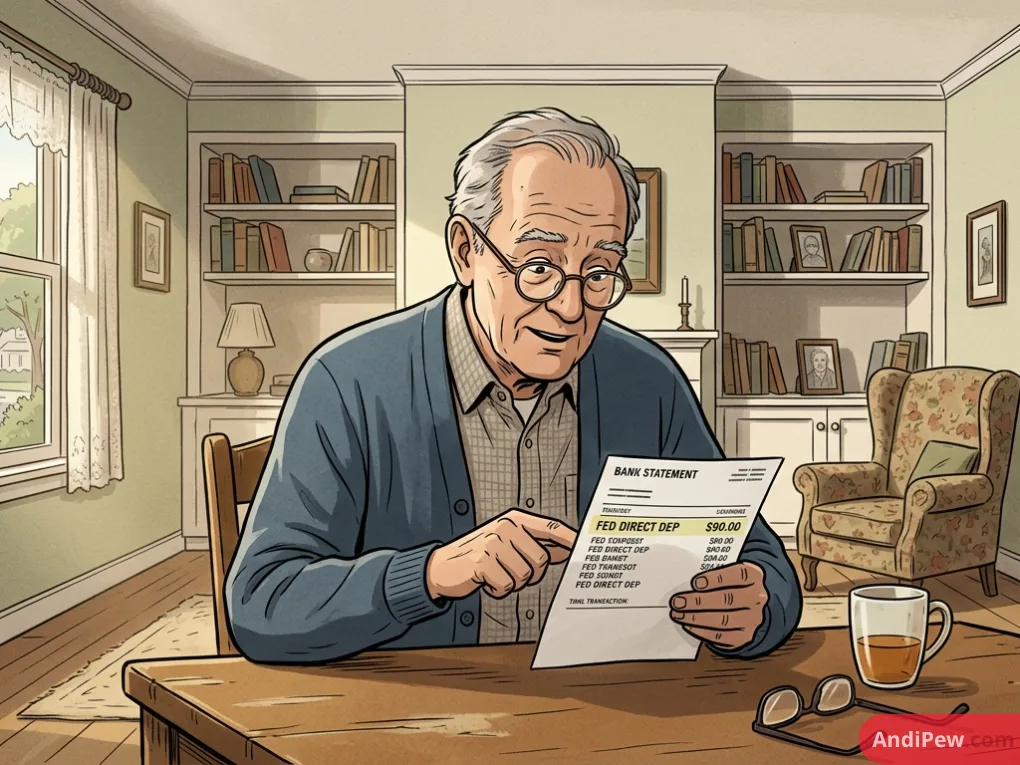
If you checked your bank account this week and noticed an unexpected $90 deposit from the Social Security Administration (SSA), you are not alone. Millions of American seniors opened their checking accounts or mailboxes in early October to find this exact figure, immediately wondering: Is this real? Did Social Security make a mistake? Will I have to pay this back?
Rest assured: the $90 payment is legitimate, and you do not have to pay it back.
The money is part of a one-time federal initiative announced by the Trump administration to offset rising Medicare Part B premiums for approximately 20.8 million eligible beneficiaries.
Here is everything you need to know about why you received $90 from Social Security, where the money came from, who qualifies, and how it impacts your regular monthly benefits.
Why Did I Receive $90 From Social Security?
The core reason you see a $90 payment is tied directly to your Medicare Part B coverage, not a permanent increase in your regular retirement benefits.
In early October, the Trump administration announced a one-time federal rebate designed to help seniors cope with escalating healthcare costs. For most retirees, monthly Medicare Part B premiums are deducted automatically from their Social Security checks. Because the Social Security Administration handles these deductions, the federal government utilized the SSA’s payment system to distribute the $90 rebate back to enrollees.
If you received the payment via direct deposit or a paper check, you may notice it labeled under descriptions such as:
- “SSA TREAS 310” or “FED SALARY / BENEFIT” with a $90 credit
- Paper checks stating: “Medicare Improvement Fund Payment; $90 Payment to Offset October Premium”
The primary purpose of this $90 payment is to serve as a partial offset for your October Medicare Part B premium, which stands at $202.90 per month.
Where Did the $90 Come From?
The funds do not come from the standard Social Security Old-Age and Survivors Insurance (OASI) Trust Fund. Instead, the money is sourced from the Medicare Improvement Fund (MIF).
Congress originally created the Medicare Improvement Fund to give federal health officials a mechanism to make adjustments and enhancements to traditional fee-for-service Medicare. The administration elected to tap the fund’s roughly $2 billion balance to provide immediate, direct cash relief for outpatient healthcare costs.
Who Is Eligible for the $90 Medicare Payment?
While over 62 million Americans are enrolled in Medicare, only about 20.8 million seniors qualify for this $90 payment. This is why your spouse, relative, or neighbor might not have received a deposit even if they are retired.
Eligibility Checklist
To qualify for the $90 rebate, you generally must meet all of the following criteria:
- Enrolled in Original Medicare Part B: You must receive standard Medicare Part B (which covers outpatient services and doctor visits).
- Reside in the United States: Beneficiaries living abroad are not eligible.
- Pay Your Own Premiums: You cannot receive Medicaid assistance or Medicare Savings Programs that pay your Part B premiums for you.
- Not Subject to IRMAA: High earners who pay an Income-Related Monthly Adjustment Amount (an extra surcharge on Part B) do not qualify.
Who Does Not Qualify?
Roughly 40 million Medicare enrollees are excluded from this payment round:
| Beneficiary Category | Eligible for $90? | Reason for Exclusion |
| Original Medicare Part B Recipients | Yes | Standard enrollees paying regular base premiums out-of-pocket. |
| Medicare Advantage (Part C) Enrollees | No | CMS guidelines limit this specific disbursement to fee-for-service Original Medicare. |
| Dual-Eligible / Medicaid Recipients | No | State Medicaid programs already cover Part B premiums on their behalf. |
| High Earners Paying IRMAA | No | Beneficiaries subject to higher-tier income surcharges are excluded under program guidelines. |
Does This $90 Deposit Affect Your Monthly Social Security Check?
A common worry among beneficiaries is whether this surprise deposit replaces their upcoming monthly check or indicates a reduction later.
The short answer: No.
- It does not replace your regular payment: Your normal monthly Social Security retirement, SSDI, or survivor benefit will arrive on its scheduled date based on your day of birth.
- It is not taxable as wages: This is a premium rebate/offset, not wage income.
- You do not have to repay it: You do not need to contact the SSA to return the funds unless you received multiple duplicate deposits by error.
- It is a one-time payment: This is not an ongoing, monthly $90 raise.
When Will Physical Checks Arrive?
If you receive your regular Social Security benefits via direct deposit, the $90 payment likely landed in your account during early October.
If you do not have direct deposit on file with the Social Security Administration or Medicare, a physical paper check was issued by mail to the address currently registered with Medicare. Treasury paper checks typically take 5 to 10 business days to navigate the postal system, meaning paper checks should reach most homes by mid-to-late October.
Watch Out for $90 Medicare Scams
Whenever government agencies distribute money, opportunistic scammers emerge.
- The SSA and Medicare will NEVER call, text, or email asking for your bank account number, Social Security number, or debit card to “release” your $90 payment.
- The payment is issued automatically. There is no application, registration fee, or confirmation portal required.
- If someone calls claiming to be from Medicare or Social Security demanding personal information or money in exchange for your check, hang up immediately.
Frequently Asked Questions (FAQ)
Why am I getting $90 from Social Security if I didn’t apply?
The payment is completely automatic. The Centers for Medicare & Medicaid Services (CMS) and the SSA identified all eligible beneficiaries enrolled in Original Medicare Part B and issued the funds directly to their existing payment profile.
Is the $90 payment related to the 2027 COLA increase?
No. The annual Cost-of-Living Adjustment (COLA) applies a permanent percentage adjustment to your monthly gross benefits starting each January. The $90 check is an isolated, one-time rebate funded through the Medicare Improvement Fund.
Is this payment the same as the $5,000 dividend or ACA refunds?
No. This payment is strictly for Medicare Part B enrollees. It is entirely separate from proposals like the “Trump Dividend” and separate from the refund checks sent to certain Affordable Care Act (ACA) policyholders.
What should I do if I think I was eligible but didn’t receive the payment?
If you believe you meet all criteria (enrolled in Original Medicare Part B, not on Medicaid, and not paying IRMAA) but did not receive a deposit or check:
- Contact Medicare at 1-800-MEDICARE (1-800-633-4227) to verify your eligibility status.
- Contact the Social Security Administration at 1-800-772-1213 to check payment and mailing status.
Conclusion
Finding an unexpected line item on your bank statement can be unsettling, but in this case, the $90 deposit from Social Security is a verified, legitimate relief payment. Funded through the Medicare Improvement Fund, it is intended to help offset the cost of your Medicare Part B premium. Your regular monthly Social Security benefits will continue arriving right on schedule.
Did you receive your $90 deposit, or are you still waiting on a paper check? Review your my Social Security account or call 1-800-MEDICARE to ensure your mailing address and direct deposit information are fully up to date.