

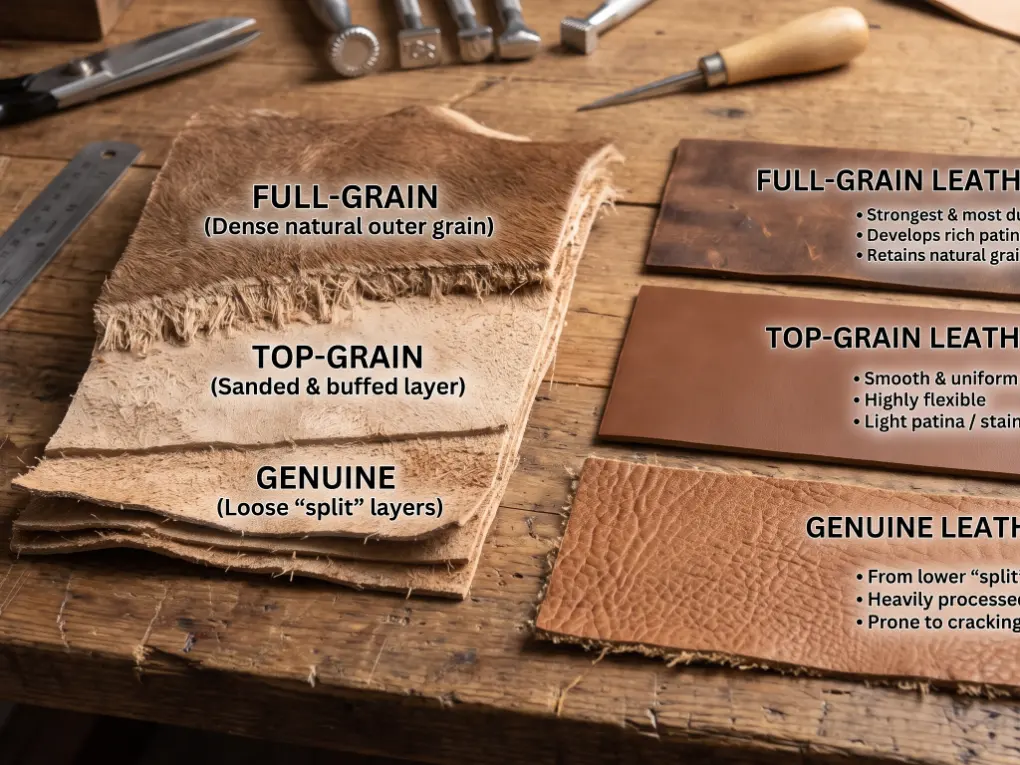
The short answer is straightforward: buy full-grain leather if you want an accessory that lasts a decade and develops a rich patina, or choose top-grain if you require a slim profile and uniform colouring straight out of the box. Skip anything stamped “genuine leather” if longevity matters, and avoid bonded leather altogether.
When comparing full grain vs top grain vs genuine leather, the distinction refers entirely to which cross-sectional layer of the animal hide is utilised and how heavily that layer has been buffed, sanded, or chemically coated by the tannery. Full-grain retains the complete exterior grain layer intact, top-grain sands off surface imperfections for consistent thickness, while genuine leather typically repurposes fibrous lower split layers.
In short:
- Full-grain retains the natural, outermost grain intact; it is the most durable, ages with a distinct patina, and represents the best investment for daily-carry goods.
- Top-grain sands away surface imperfections for a uniform finish; it provides flexibility and reduced bulk for slim accessories.
- “Genuine leather” is a legal classification indicating the product contains real animal hide, but it typically relies on weak bottom split layers coated in polyurethane.
- Bonded leather consists of shredded leather scraps pulped together with synthetic adhesives; it fails quickly and belongs nowhere near your wardrobe.
- Tanning method matters: Vegetable tanning yields structured, patina-prone leather, whereas chrome tanning provides soft, water-resistant material immediately.
Basis: Based on manufacturer specifications, material cross-sections, and owner reports; not hands-on tested.
How leather is graded
Leather grading is not a quality inspection badge issued by a government board; it simply describes the horizontal split of an animal hide and the mechanical processing applied to it.
An animal hide consists of two primary anatomical zones: the grain (the exterior layer beneath the hair) and the corium (the internal layer adjoining the flesh). The hair side contains densely interlocked collagen fibres responsible for tensile strength, structural resilience, and natural moisture resistance. As you slice downwards into the corium, these fibres become loose, spongy, and structurally weak.
When raw hides arrive at a tannery, they average 4 to 6 millimetres in thickness. Because un-split leather is too bulky for a pocket accessory, tanneries run the hide through industrial splitting machines.
- The Upper Cut: Retains the dense grain layer. This cut becomes full-grain or top-grain leather.
- The Lower Cut (Split): Consists strictly of loose corium fibres with zero natural grain. This cut becomes suede, split leather, or coated “genuine leather”.
Understanding where your accessory sits along this cross-section determines whether it softens and characterises over 10 years, or cracks within 18 months.
Full-grain: signs, patina, and pricing
Full-grain is the gold standard of hide preparation. Tanneries leave the natural grain layer untouched—no sanding, no buffing, and no heavy polymer snuffs designed to disguise natural variations.
Identifying marks
Because the epidermis remains intact, full-grain leather reveals the animal’s lived history. Under close inspection or magnification, you should see:
- Pore patterns: Clearly identifiable, irregular microscopic pores rather than a stamped repeating matrix.
- Natural variations: Subtle stretch marks, healed barbed-wire scars, or minor insect bites.
- Dense edge cross-sections: Clean cut edges show tight, dense fibres right at the surface, seamlessly transitioning to the reverse side without laminated synthetic layers.
The patina process
Patina is the natural oxidation and absorption process unique to unsealed full-grain leather. As you handle the leather, it absorbs skin oils, ambient humidity, sunlight, and friction. Rather than wearing out, the surface develops a rich sheen, darkens in high-contact areas, and moulds to the shape of whatever you carry.
What you should expect to pay
Because tanneries can only use unblemished hides for full-grain stock, material rejection rates are high. In Australia, expect to pay:
- Wallets: Typically $130.00 to $250.00 AUD for dedicated local and artisanal makers.
- Watch straps: Typically $80.00 to $180.00 AUD.
- Bracelets: Typically $60.00 to $120.00 AUD.
Top-grain: when it is the sensible choice
Top-grain leather starts life from the same outer cut of hide as full-grain. However, tanneries sand or buff off the topmost micro-layer to erase scars, insect marks, and irregular grain. After buffing away surface blemishes, tanneries apply an acrylic or polyurethane finish, often followed by an embossed artificial texture.
This sanding process strips away a fraction of the hide’s strongest superficial fibres. It will never age with the deep character of full-grain, but top-grain should not be dismissed as inferior. It serves specific functional purposes:
- Slim construction: Sanding allows the hide to be shaved down uniformly to fractions of a millimetre without falling apart, making it ideal for engineered front-pocket wallets.
- Stain and water resistance: The sealed protective topcoat prevents water drop stains and oil absorption.
- Colour consistency: If you order an accessory in navy or tan, top-grain ensures the hue remains uniform for its entire working lifespan.
For instance, Australian brand Bellroy uses premium top-grain hides extensively across their range to maintain tight pocket footprints without unnecessary bulk. The popular Bellroy Slim Sleeve retails at $119.00 AUD (Bellroy, price checked: 10 November 2026). For men who wear slim tailored trousers and do not want oil-darkened marks on their leather, top-grain represents the most sensible, functional option.
Genuine leather: why the name misleads
“Genuine leather” is technically not a lie, but it is one of the most deceptive marketing classifications in retail.
Legally, an item labelled “genuine leather” contains real animal hide rather than a petroleum vinyl like PVC or polyurethane. However, in retail practice, manufacturers almost always use split leather.
When the dense top grain is sliced off to make high-end goods, the loose, fibrous corium underneath is left behind. This scrap layer possesses virtually no inherent tensile strength, water resistance, or structural firmness. To make it usable:
- The tannery sprays or laminates a solid sheet of polyurethane or pigment onto the rough split layer.
- A heavy heated press stamps an artificial pebbled grain pattern into the synthetic face.
The consequence is immediate: genuine leather cannot develop a patina. Within 6 to 24 months of friction, the thin synthetic outer surface begins peeling, bubbling, and cracking away from the fibrous backing. You will see “genuine leather” stamped on $30.00 AUD department store belts and mass-market discount wallets. For an everyday accessory, it represents false economy.
Bonded leather: avoid entirely
Bonded leather (sometimes sold under names like reconstituted leather, blended leather, or engineered leather) is the particle-board equivalent of the textile trade.
Manufacturers collect scrap shavings, dust, and discarded hide offcuts from factory floors. These offcuts are shredded into a pulp, blended with synthetic polyurethane or latex bonding agents, extruded onto a gauze fabric mesh backing, and embossed with a roller stamp. In many instances, the actual hide content constitutes as little as 10% to 20% of the material weight.
Bonded leather cannot breathe. It does not stretch; instead, it shears. It will split along flex folds, peel around edges within months of routine friction, and cannot be reconditioned with leather cream. If you see an accessory labelled bonded leather, skip it entirely.
Vegetable-tanned vs chrome-tanned
Hide grading tells you which layer you bought; tanning describes how that hide was preserved. Raw skins rot without tanning. The two dominant tanning methods define how your accessory looks, smells, and performs:
Vegetable tanning (veg-tan)
An artisanal method utilising organic bark extracts, quebracho, chestnut, and natural tannins. The process takes anywhere from 4 to 12 weeks inside circulating tanning pits.
- Characteristics: Firm hand-feel, distinct organic smell, initial stiffness, and exceptional patina potential.
- Best applications: Heavy utility belts, unlined cardholders, and structured straps.
Chrome tanning
An industrial method using chromium sulphate salts, accounting for roughly 80% to 90% of global leather output. It takes less than 24 hours to complete.
- Characteristics: Supple out of the box, soft drape, superior water and stain repellency, and stable dyed colouration.
- Best applications: Lined billfolds, dress watch straps, and casual jackets.
A full-grain, vegetable-tanned hide yields maximum character and longevity, while a top-grain, chrome-tanned hide delivers flexibility and low maintenance.
Which grade for which product: wallet, watch strap, or bracelet
Accessories encounter differing levels of friction, moisture, and structural stress. Use this breakdown to decide what grade fits your wrist and pocket:
| Feature / Criteria | Men’s Wallets | Watch Straps | Leather Bracelets |
| Recommended Grade | Full-grain (rugged) or Top-grain (slim) | Full-grain or high-grade Top-grain | Full-grain vegetable-tanned |
| Why This Grade Wins | Pocket friction demands tight fibre density to resist edge fraying. | Lug holes and buckle pinholes stretch rapidly on weak split hides. | Constant exposure to wrist sweat and skin oils dissolves laminated synthetics. |
| Grade to Avoid | Genuine & Bonded leather | Any split or bonded leather | Genuine leather splits & faux cords |
| Typical Target Dimensions | 10 cm × 8 cm closed; thickness under 1.2 cm | 18 mm to 22 mm lug width; 2 mm to 4 mm thickness | 19 cm to 21 cm circumference; 4 mm to 8 mm width |
| Expected Lifespan | 5 to 15+ years | 1 to 3 years of daily rotation | 2 to 5 years (dependent on water contact) |
| Typical Australian Price Range | $80.00 – $220.00 AUD | $50.00 – $150.00 AUD | $45.00 – $110.00 AUD |
When looking at men’s leather wallets Australia, prioritise construction thickness: pick full-grain if you prefer raw edge finishes and thick thread, or top-grain if pocket bulk is your primary concern. For replacement leather watch straps Australia, select straps with clear full-grain outer layers so buckle holes do not tear out under tension. If you are shopping for men’s leather bracelets Australia, demand solid cut vegetable-tanned cords that handle natural body heat without falling apart.
Who this is for / Who should skip it
Who should invest in full-grain:
- Men looking to buy one everyday piece to carry for the next decade.
- Buyers who appreciate visible patina, darkening tones, and unique material markings.
- Men who do not mind occasional conditioning with natural leather balms.
Who should buy top-grain instead:
- Men who carry front-pocket card sleeves and cannot tolerate added millimetres of pocket bulk.
- Professionals needing a consistent, formal dye finish (like uniform black or oxblood) that resists scuff marks and oil stains.
- Anyone seeking a balance between genuine durability and modern, clean-lined aesthetics.
Who should skip both and save their money:
- Buyers looking strictly for a disposable $15.00 AUD festival wristband or a cheap stop-gap accessory. If you are not prepared to spend $50.00 to $100.00 AUD for quality hide, durable ballistic nylon or canvas will outlast cheap “genuine leather” every single time.
Frequently asked questions
Does full-grain leather scratch easily?
Yes, full-grain leather picks up surface scuffs and marks more readily than treated hides because it lacks a synthetic polyurethane topcoat. However, natural oils from your hands and periodic treatment with a beeswax or lanolin-based conditioner blend these marks into the evolving patina over time.
Can top-grain leather develop a patina?
Top-grain leather develops very little patina because the protective polymer or pigment seal applied during processing blocks moisture, sunlight, and skin oils from directly reaching the raw fibres. While it will soften with use, its surface colour will remain largely the same as the day you bought it.
Why do some luxury designer brands use top-grain or coated leather?
High-end fashion fashion houses often select top-grain or crossgrain-stamped leathers because luxury accessories require absolute colour uniformity across thousands of units. A buffed, sealed hide guarantees an immaculate, pristine finish that resists water marks and daily makeup or pen stains.
How can you tell if an item is real full-grain in a store?
Inspect the cut edges, examine the surface grain pattern with a magnifying lens, and check how the hide reacts to light pressure. Full-grain shows varied pore spacing, subtle animal blemishes, and dense, fibrous cut edges rather than smooth rubberised paint covering a multi-layered plastic split.
Conclusion
Understanding the reality behind hide grades protects you from paying premium prices for cheap tannery splits. For items you handle multiple times a day, full-grain remains unmatched for durability and individual character, while top-grain offers an intelligent compromise for slim, uniform modern tailoring. Take a moment to evaluate your current everyday carry, and check our focused guides on men’s leather wallets Australia, durable leather watch straps Australia, and men’s leather bracelets Australia before making your next purchase.
