
Whether you are restoring a classic 1967 Mustang, hunting through a local junkyard for a project car, or swapping a modern EcoBoost into a vintage truck, knowing how to accurately identify a Ford motor is one of the most vital skills you can master.
Ford Motor Company has manufactured dozens of engine families over the last century—ranging from classic Y-Blocks and Small Block Windsors to FE Big Blocks, 385-Series monsters, Modular V8s, and modern Coyote or EcoBoost powerplants.
Because Ford frequently shared engine components across different vehicle models and decades, visual appearance alone can lead to costly mistakes. Installing parts designed for a 351 Cleveland onto a 351 Windsor, for example, will stop your build in its tracks.
This comprehensive guide breaks down the exact steps to identify a Ford motor using block casting numbers, date codes, VIN characters, foundry logos, and distinct physical features.
Why Is Engine Identification Critical for Ford Vehicles?
Before turning a single wrench, you need complete certainty about the displacement, year range, and design family of your powertrain.
Here is why accurate identification matters:
- Ordering Correct Replacement Parts: Internal components like pistons, pushrods, oil pumps, and gaskets vary significantly even within the same engine family.
- Avoiding Swap Compatibility Pitfalls: Transmission bellhousing bolt patterns, engine mounts, and starter positions changed significantly across production years.
- Verifying Numbers-Matching Value: For classic car collectors, confirming that an engine block possesses the correct date code and serial prefix directly impacts vehicle valuation.
- Preventing Misbadged Purchases: Sellers often mistake a standard 350-series or 302 engine for a high-performance 351 Cleveland or Cobra Jet.
Where to Find Ford Engine Casting Numbers and Stamped Codes
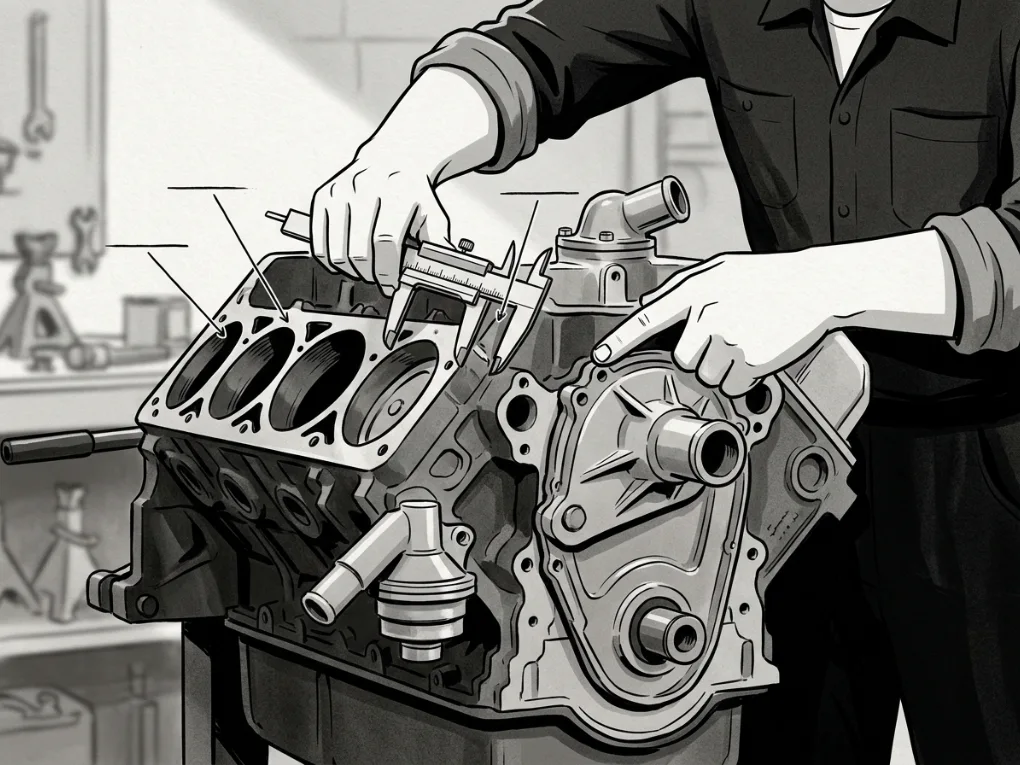
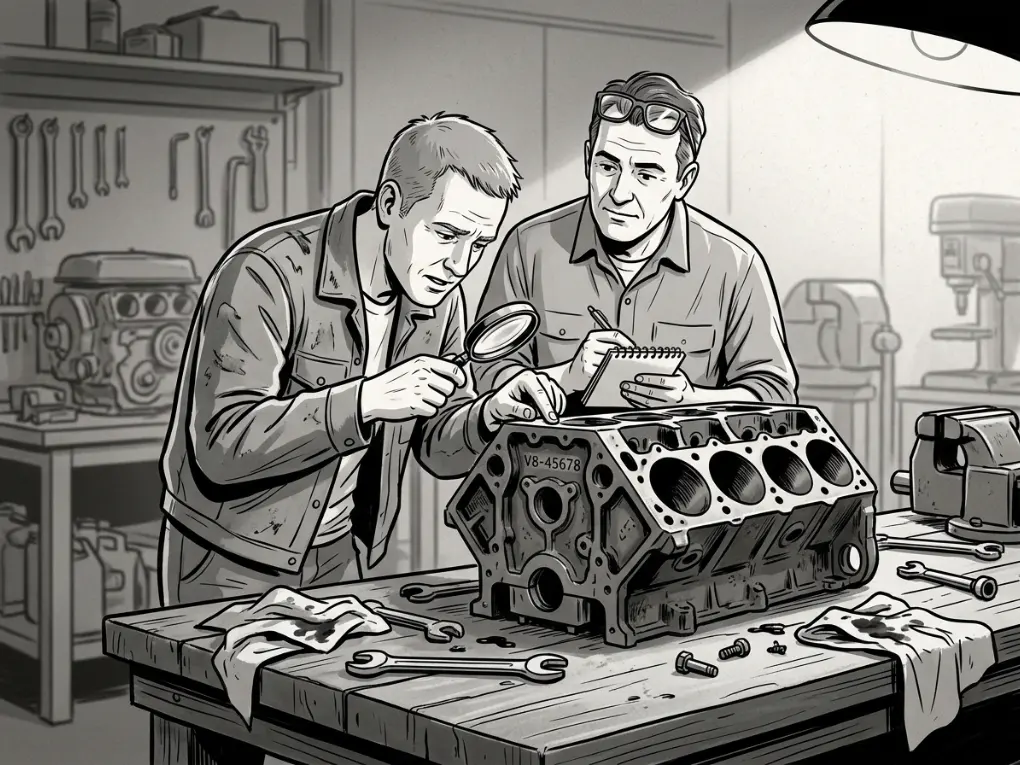
To get accurate information, you must look for two main types of markings on the engine block: Casting Numbers (raised numbers molded during metal pouring) and Stamped Numbers (chiseled or stamped into flat machined pads).
+--------------------------------------------------------------------+
|                TYPICAL FORD ENGINE BLOCK MARKINGS                  |
|                                                                    |
|   1. Casting Number (e.g., C9OE-6015-B) -> Cast in raised metal   |
|   2. Casting Date Code (e.g., 9A26)     -> Cast near casting code  |
|   3. Stamped Serial Pad                 -> Machine-stamped code    |
|   4. Foundry Identification Logo        -> e.g., CF, DIF, or WF    |
+--------------------------------------------------------------------+
Common Casting Number Locations
- Rear Right Starter Flange: On classic Windsor (289, 302, 351W) and Cleveland engines, look on the lower right rear side of the block, directly behind where the starter mounts.
- Under the Intake Manifold or Valley: On FE Series V8s (352, 390, 427, 428), casting numbers are frequently located on the lifter valley floor or near the cylinder head deck.
- Bellhousing Mating Surface: On modern Modular 4.6L/5.4L and Coyote V8s, numbers are cast on the top or side flange where the transmission mounts.
- Front Engine Face: On industrial and early British-built Ford engines, codes appear on the front left or right side near the water pump flange or timing cover.
Pro Tip: Bring a wire brush, brake cleaner, and a flashlight when inspecting an engine. Decades of grease, road grime, and high-temp engine paint routinely obscure low-relief casting marks.
Decoding Ford Casting Numbers: The 4-Part Formula
Ford introduced a standardized part-numbering system in the late 1950s that makes decoding straightforward once you understand the formula.
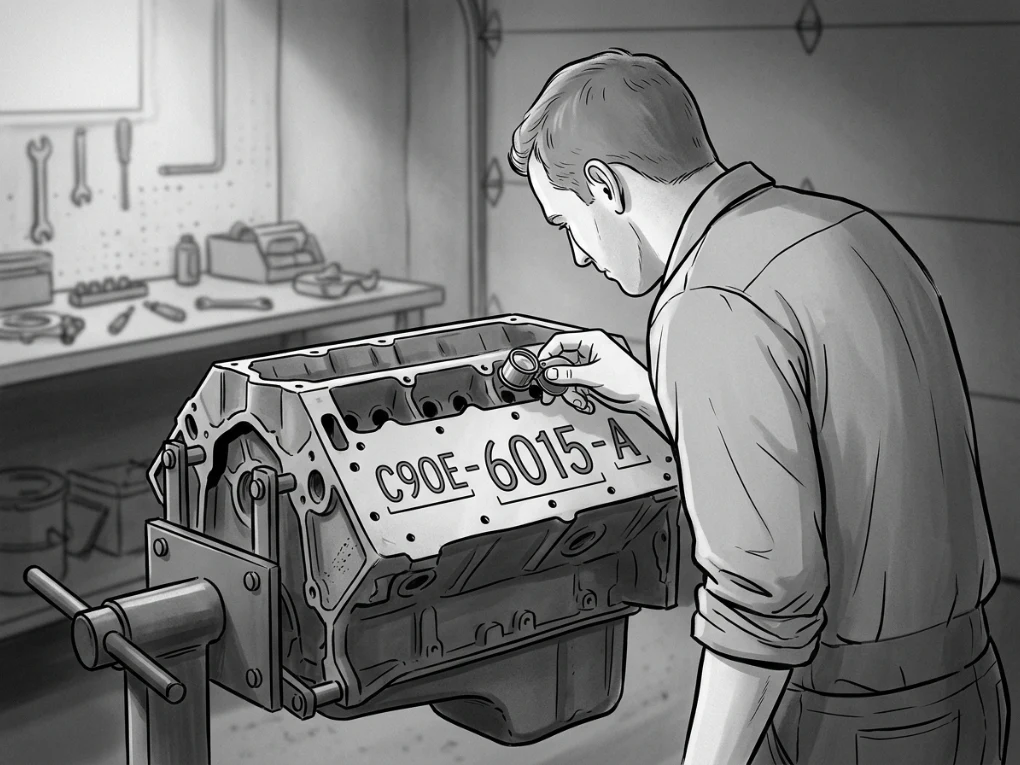
A standard Ford casting code follows a structure such as C9OE-6015-A:
      C         9         O         E    -    6015    -    A
   [Decade]  [Year]   [Model]   [Dept]      [Part]     [Revision]
1. First Position: The Decade Letter
The first character tells you the decade in which the part was engineered:
| Character | Decade |
| B | 1950s |
| C | 1960s |
| D | 1970s |
| E | 1980s |
| F | 1990s |
| 1 | 2000s |
| 2 | 2010s |
2. Second Position: Year Within the Decade
The second character represents the exact design year within that decade.
C9= 1969D2= 1972E7= 1987F1= 1991
3. Third Position: Vehicle Line / Target Model
The third letter indicates the vehicle application for which the component was originally developed:
- A: Full-size Ford (Galaxie, LTD)
- D: Falcon / Maverick
- E: Truck / SUV / Van
- O: Fairlane / Torino / Ranchero
- S: Thunderbird
- T: Truck & Commercial
- V: Lincoln
- W: Cougar
- Z: Mustang
(Note: While this character indicates the original design platform, Ford frequently used identical engine castings across multiple car lines.)
4. Fourth Position: Engineering Division
The fourth character identifies the Ford division responsible for the design:
- E: Engine Engineering Group
- F: Electrical and Electronics
- M: Performance / Special Vehicle Operations (SVO) / Holman Moody
- Z: Service Replacement Parts
5. Middle Group: The Basic Part Number
The numeric block in the middle identifies what component the part is:
6015= Engine Cylinder Block6049= Cylinder Head9425= Intake Manifold9510= Carburetor / Fuel System
6. Suffix Letter: Engineering Revision
The trailing letter(s) indicate revision updates (e.g., -A, -B, -AA). A change in suffix might signal altered main-cap bolt configs, oil gallery adjustments, or cylinder wall thickness changes.
Decoding Ford Date Codes and Foundry Identification Marks
A casting prefix tells you when a block was designed, but the casting date code reveals when the metal was actually poured in the foundry.
Understanding the Casting Date Code
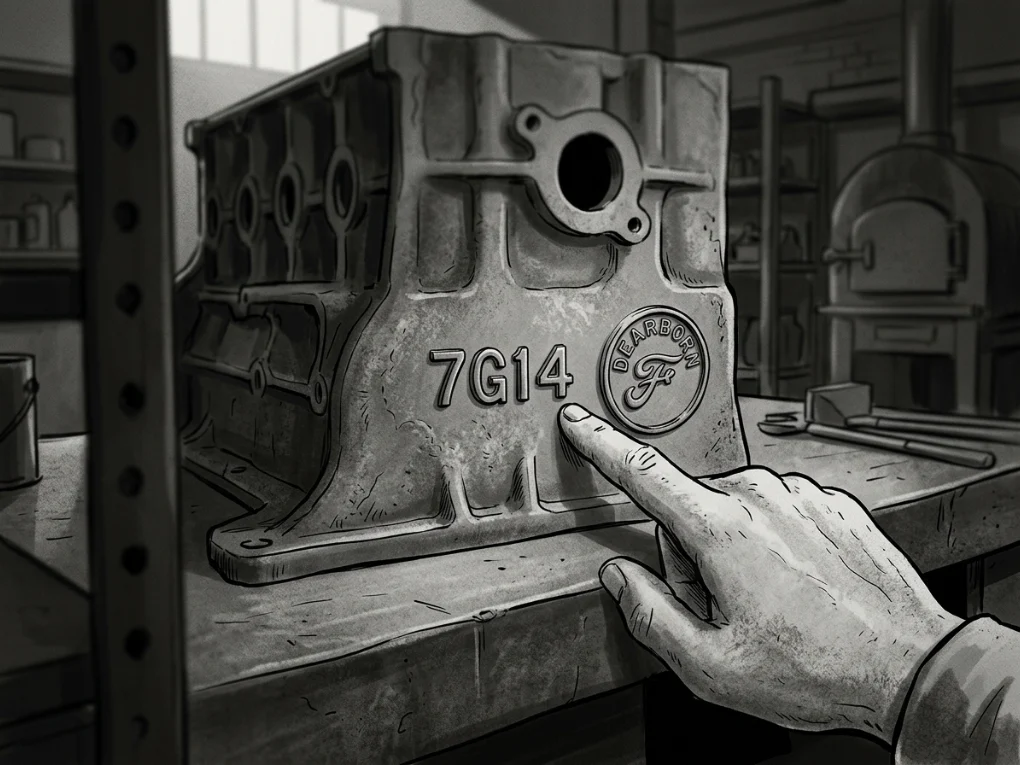
Found near the main casting prefix, the date code usually consists of three or four characters (e.g., 9A26):
-
Digit 1 (Year):
9= 1969 (or 1979, 1989—cross-reference with the decade letter). -
Digit 2 (Month): Uses letters A through M (skipping ‘I’ to avoid confusion with the number ‘1’):
-
A = January, B = February, C = March, D = April, E = May, F = June, G = July, H = August, J = September, K = October, L = November, M = December.
-
-
Digits 3 & 4 (Day):
26= 26th day of the month.
Therefore, 9A26 indicates a casting date of January 26, 1969.
+--------------------------------------------------------------------+
|                     FORD FOUNDRY IDENTIFICATION                    |
|                                                                    |
|  [ CF ] -> Cleveland Iron Foundry (Circled 'C' with 'F' inside)    |
|  [ DIF] -> Dearborn Iron Foundry                                   |
|  [ WF ] -> Windsor Iron Foundry                                    |
|  [ MCC] -> Michigan Casting Center                                 |
+--------------------------------------------------------------------+
These foundry marks are cast directly into the lifter valley, valve cover deck, or outer block wall.
How to Identify a Ford Motor by Physical Features
When casting numbers are difficult to reach or rusted over, you can identify many Ford V8 engine families by examining physical construction details.
                  +-----------------------------------+
                  |   COUNT YOUR VALVE COVER BOLTS    |
                  +-----------------------------------+
                                    |
          +-------------------------+-------------------------+
          |                         |                         |
       2 Bolts                   5 Bolts                   6 Bolts
   (Y-Block Family)          (FE Big Block)            (Windsor Small Block)
          |                         |                         |
          +-------------------------+-------------------------+
          |                         |                         |
       7 Bolts                   8 Bolts                  12+ Bolts
   (385 Series Big Block)     (Cleveland / 335)         (Modular / OHC V8s)
1. Small Block Windsor Family (221, 255, 260, 289, 302, 351W)
- Valve Cover Bolts: 6 bolts per cover.
- Thermostat Housing: Mounts directly to the front face of the intake manifold.
- Distributor Position: Vertically mounted at the front left of the engine.
- Distinguishing 302 vs 351W: The 351W features a taller deck height. Look at the space between the top of the water pump housing and the lower edge of the intake manifold. On a 302, they almost touch; on a 351W, there is roughly a 1.5-inch vertical gap.
2. Cleveland / 335-Series Family (351C, 351M, 400)
- Valve Cover Bolts: 8 bolts per cover with straight rectangular edges.
- Thermostat Housing: Mounts directly into the top of the engine block casting (dry intake manifold).
- Timing Cover: Integrated flat cast-iron front face with no separate aluminum timing cover backing plate.
3. FE Big Block Family (332, 352, 360, 390, 406, 427, 428)
- Valve Cover Bolts: 5 bolts per cover.
- Intake Manifold Design: Distinctive extra-wide design extending underneath the valve covers. Removing a valve cover exposes part of the intake manifold seal deck.
- Overall Mass: Massive cast-iron construction designed for heavy automotive and truck duty.
4. 385-Series Big Block Family (370, 429, 460)
- Valve Cover Bolts: 7 bolts per cover.
- Thermostat Housing: Positioned on the front of the intake manifold pointing straight up or angled.
- Block Profile: Significantly wider than a Windsor or Cleveland block, with a smooth, heavy-duty outer wall structure.
5. Vintage Y-Block Family (239, 256, 272, 292, 312)
- Valve Cover Bolts: 2 bolts passing straight through the top center of each valve cover.
- Distinguishing Feature: Deep skirt crankcase extending well below the crankshaft centerline, stacked intake runners, and rear-mounted distributor.
Quick Reference Comparison Table for Ford Engine Families
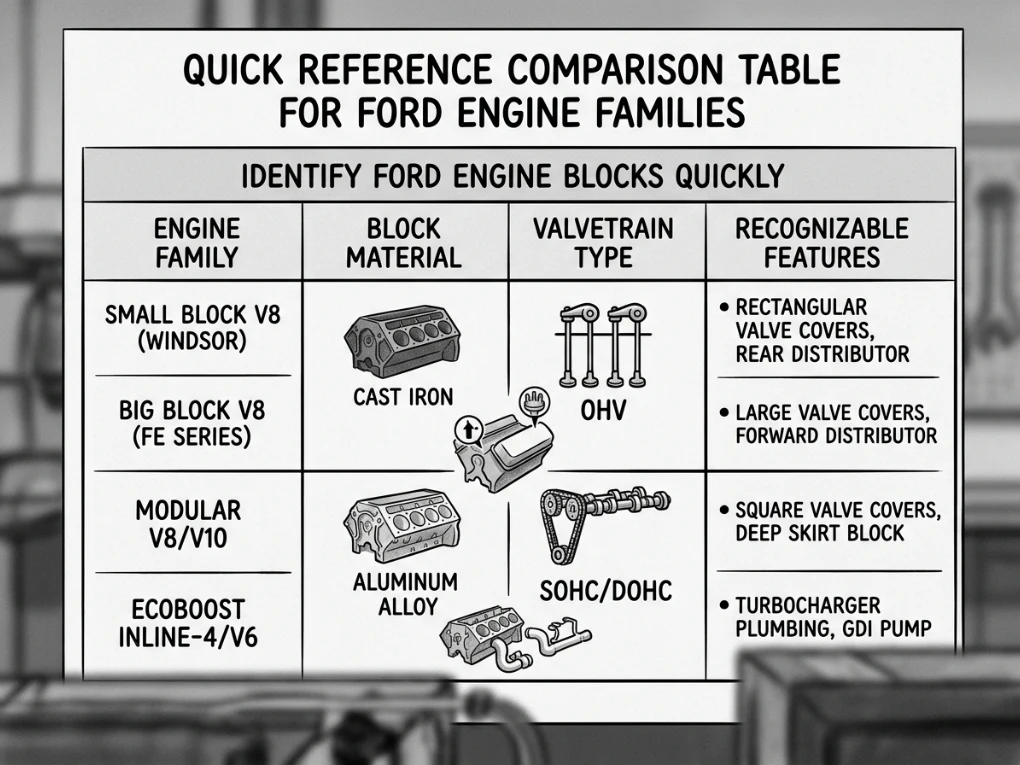
Use this side-by-side reference table to identify Ford engine blocks quickly:
| Engine Family | Common Displacements | Valve Cover Bolt Count | Thermostat Housing Location | Primary Casting Number Location |
| Windsor Small Block | 289, 302 (5.0L), 351W | 6 | Front of Intake Manifold | Lower right rear near starter |
| Cleveland / 335 | 351C, 351M, 400 | 8 | Top of Engine Block | Right rear flange or lifter valley |
| FE Big Block | 352, 360, 390, 427, 428 | 5 | Front of Intake Manifold | Lifter valley or lower block edge |
| 385 Series Big Block | 429, 460 | 7 | Front of Intake Manifold | Lower right rear passenger side |
| Modular V8 | 4.6L, 5.4L (2V, 3V, 4V) | 11–14 | Coolant Crossover Pipe | Driver side side-block pad |
| Coyote V8 | 5.0L (2011–Present) | Multi-bolt Composite | Front Water Crossover Assembly | Left rear block bellhousing flange |
How to Identify a Ford Motor Using the VIN Number
If the engine is still installed in its original chassis, the vehicle’s 17-digit Vehicle Identification Number (VIN) provides the fastest identification route.
+--------------------------------------------------------------------+
|                  17-DIGIT FORD VIN CODE STRUCTURE                  |
|                                                                    |
|    1 F A F P 1 E  [N]  1 F 1 0 0 0 0 1                             |
|                    |                                               |
|                    +--> 8TH DIGIT = ENGINE IDENTIFIER CODE         |
+--------------------------------------------------------------------+
Steps to Read the Engine VIN Code:
- Locate the VIN plate at the driver’s side dashboard base or on the driver-side door jamb sticker.
- Count to the 8th character of the 17-digit string.
- Cross-reference this single character against Ford VIN decoding tables.
Common Ford 8th-Digit VIN Engine Examples:
F= 5.0L V8 (Coyote / Mustang GT)P= 5.0L V8 (HO / Classic Mustang)H= 351W V8 (2-barrel)R= 428ci Cobra Jet V8 / 5.2L Supercharged Predator V8G= 3.5L EcoBoost V6 (F-150)X= 4.6L SOHC V8
(Note: For classic Ford vehicles built prior to 1981, VIN lengths varied between 11 and 13 digits, but the engine code digit was still prominently featured within the first 5 characters.)
Difference Between Stamped Engine Serial Numbers and Casting Numbers
A common point of confusion when identifying a Ford engine block is mixing up casting numbers with stamped numbers:
+--------------------------------------------------------------------+
| CASTING NUMBER vs. STAMPED ENGINE NUMBER                           |
|                                                                    |
| Casting Number:  Raised metal | Shows engineering design code  |
| Stamped Number:  Engraved     | Shows specific serial / partial VIN|
+--------------------------------------------------------------------+
- Casting Numbers: Cast into the mold during manufacturing at the foundry. Multiple blocks produced over several years can share the exact same casting number.
- Stamped Numbers: Hand-stamped or machine-chiseled into a smooth, flat machined pad on the block after casting. These numbers represent the production date, specific assembly plant code, or partial VIN tied to a specific vehicle.
Frequently Asked Questions (FAQ)
Where is the casting number located on a Ford engine block?
On most classic Ford V8 blocks, the casting number is located on the rear right side of the engine block near the starter mounting flange or near the bellhousing attachment point. On some modern OHC and EcoBoost engines, it is stamped on a machined pad along the side or oil pan rail.
What is the difference between an engine casting number and a stamped engine number?
A casting number is raised metal cast into the block during production at the foundry; it identifies the engineering group and design part number. A stamped engine number is razor-stamped into a smooth machined metal pad on the block and typically represents the specific serial number, assembly date, or partial VIN.
What digit in the Ford VIN tells you what engine it has?
The 8th character of a standard 17-digit Ford Vehicle Identification Number (VIN) specifies the engine code, indicating the original displacement, cylinder count, and fuel system installed at the factory.
What does the code 6015 mean on a Ford motor?
In Ford’s part numbering system, ‘6015’ is the universal basic part group number for an engine block assembly. It confirms that the component is an engine block.
Conclusion
Knowing how to identify a Ford motor comes down to systematic decoding: locate the raised casting number on the block, cross-reference the decade and year characters, verify the casting date code, and check physical traits like valve cover bolt counts and thermostat locations. Taking a few minutes to clean off grease and inspect these markings prevents costly part mismatches and helps ensure your restoration or engine swap project runs smoothly.