
Every time you turn the ignition key or push the start button, hundreds of interconnected engineering systems work quietly to ensure you reach your destination safely. Modern car safety technology has transformed passenger vehicles from rigid steel carriages into sophisticated protective cocoons capable of sensing hazards, mitigating collision forces, and actively taking control to avoid catastrophic crashes.
Automotive safety is no longer defined solely by heavy metal bumpers and padded dashboards. Today’s vehicles combine structural mechanical engineering, high-frequency radar, optical machine vision, artificial intelligence, and advanced biomechanics. Understanding vehicle safety technology helps you make smarter purchasing decisions, maximize the protection of your passengers, and appreciate the incredible science preserving human life on public roads.
What Is the Difference?
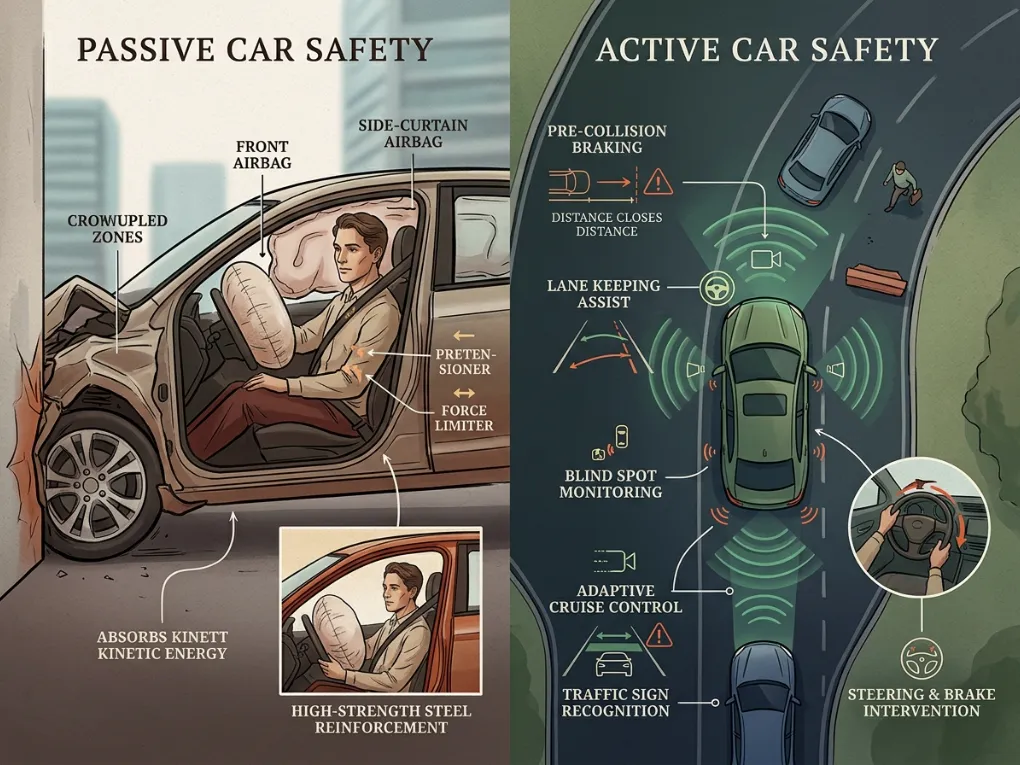
Automotive safety systems are divided into two fundamental operational categories: active safety and passive safety. Both systems work together to form a multi-layered shield for drivers, passengers, and pedestrians.
+-----------------------------------------------------------------------------------+
|                            TOTAL VEHICLE SAFETY SYSTEM                            |
+-----------------------------------------+-----------------------------------------+
|              ACTIVE SAFETY              |             PASSIVE SAFETY              |
|        (Collision Prevention)           |          (Impact Mitigation)            |
+-----------------------------------------+-----------------------------------------+
| • Radar, LiDAR & Optical Cameras        | • Crumple Zones & Deformation Paths     |
| • Automatic Emergency Braking (AEB)     | • High-Strength Boron/UHS Steel Cage    |
| • Electronic Stability Control (ESC)    | • Pre-Tensioning 3-Point Seatbelts      |
| • Blind Spot Monitoring (BSM)           | • Multi-Stage Curtain & Knee Airbags    |
| • Lane Keep Assist (LKA)                | • Whiplash Protection Head Restraints   |
+-----------------------------------------+-----------------------------------------+
Active Safety Systems: Preventing the Crash
Active safety refers to systems that operate continuously while driving to prevent collisions before they occur. These technologies monitor the vehicle’s dynamic state, ambient environment, and nearby road users, alerting the driver or automatically intervening when dangerous conditions arise.
Key active safety technologies include:
- Autonomous Emergency Braking (AEB): Detects stopped vehicles or pedestrians ahead and applies braking pressure if the driver fails to react.
- Electronic Stability Control (ESC): Automatically applies individual brakes to correct skids, oversteer, and understeer.
- Blind-Spot Monitoring (BSM): Alerts the driver to vehicles hidden in side blind spots during lane changes.
- Adaptive Cruise Control (ACC): Maintains a preset distance behind preceding traffic using radar and camera sensors.
Passive Safety Systems: Surviving the Crash
Passive safety systems activate during or immediately after a collision. Their sole engineering objective is to absorb kinetic energy, restrain occupants, and minimize the mechanical forces transferred to the human body.
Key passive safety components include:
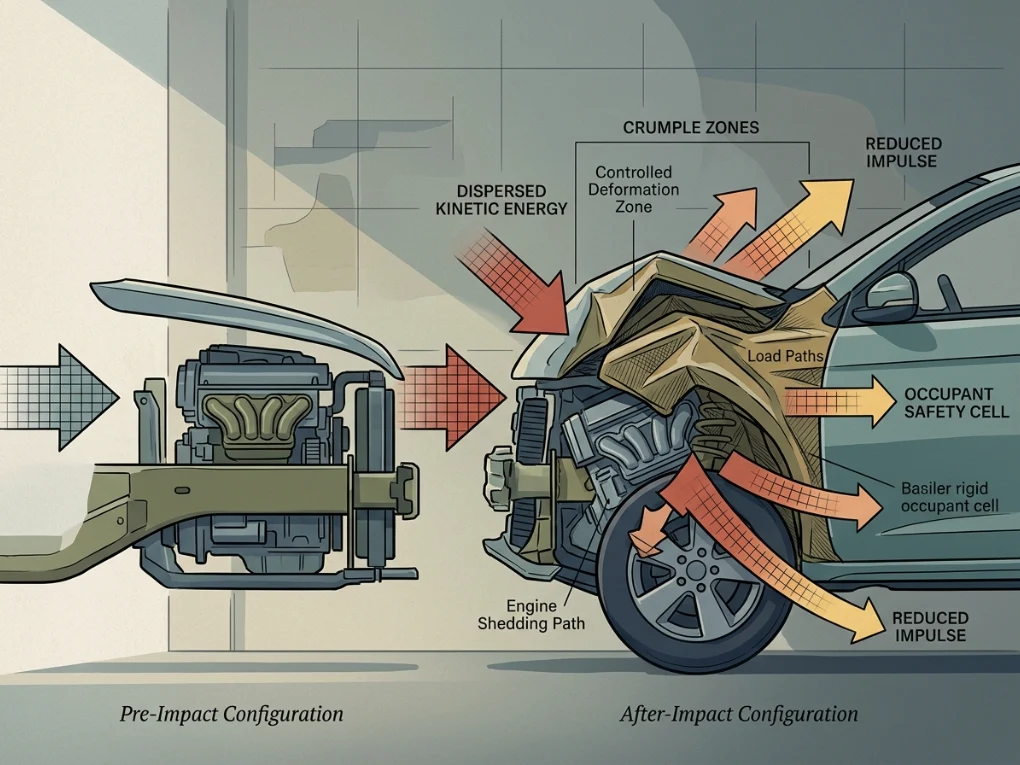
- Crumple Zones: Engineered sacrificial structural segments designed to deform progressively.
- Three-Point Seatbelts with Pre-Tensioners and Load Limiters: Hold passengers in place and release controlled slack to prevent severe chest injury.
- Supplemental Restraint Systems (Airbags): Rapidly inflating nylon cushions that prevent direct contact with hard interior surfaces.
- High-Strength Passenger Safety Cage: Reinforced passenger compartments built from ultra-high-strength steel to resist cabin intrusion.
The Physics of Car Safety Features: GCSE and High-School Mechanics Explained
The design of every structural vehicle safety feature is grounded in fundamental classical mechanics. Understanding car safety features physics reveals why modern vehicles are designed to crush and bend rather than remain completely rigid.
Newton’s Second Law and the Impulse-Momentum Theorem
When a vehicle crashes, its velocity drops from its cruising speed to zero in a fraction of a second. The change in momentum is called impulse:
Where:
- $m$ = mass of the vehicle and occupants
- $\Delta v$ = change in velocity
- $F$ = impact force experienced by the vehicle and occupants
- $\Delta t$ = duration of the collision (time taken to come to a complete stop)
Rearranging for force:
Because the mass ($m$) and velocity change ($\Delta v$) are fixed for any given crash speed, the only way to decrease the destructive force ($F$) experienced by human organs is to increase the duration ($\Delta t$) of the collision.
How Crumple Zones Exploit Collision Time
Crumple zones are sacrificial structures at the front and rear of the vehicle. When an impact occurs, these zones buckle and fold in a controlled sequence over several milliseconds.
Rigid Vehicle (No Crumple Zone):
[Speed: 60 km/h] ===> [Rigid Wall] ---> Stop Time: 0.02s ---> Massive Peak Impact Force (F)

Modern Vehicle (With Crumple Zones):
[Speed: 60 km/h] ===> [Crumple Zone Deforms] ---> Stop Time: 0.15s ---> Dramatically Reduced Force (F)
By extending the stopping time from roughly 0.02 seconds (rigid frame) to 0.12–0.20 seconds, crumple zones cut the deceleration forces acting on human bodies by up to 80%.
Newton’s First Law: Inertia, Seatbelts, and Airbags
According to Newton’s First Law of Motion, an object in motion stays in motion at constant velocity unless acted upon by an external resultant force.
When a car stops abruptly against an obstacle:
- Without seatbelts, the passenger continues traveling forward at the car’s initial velocity until striking the windscreen, steering column, or dashboard.
- Pre-tensioner seatbelts apply pyrotechnic tension instantly upon impact, locking the occupant to the vehicle chassis so they decelerate at the same rate as the vehicle.
- Load limiters let out minute lengths of webbing once safe tension thresholds are reached, preventing cracked ribs and internal organ damage.
- Airbags provide a cushioned deceleration surface that spreads the contact force over a wider surface area of the head and upper torso ($P = \frac{F}{A}$), lowering peak pressure on delicate tissues.
Essential Car Safety Features List: Modern Technologies Explained
Modern passenger vehicles house a broad array of active and passive systems. Below is a breakdown of core car safety features explained by functional domain.
                                    MODERN ADAS SENSOR SUITE

                                      [Forward Camera]
                                      (Lane / Pedestrians)
                                              |
      [Blind Spot Radar] <---- [Central Processing Unit] ----> [Blind Spot Radar]
      (Left Rear Quarter)             (Sensor Fusion)          (Right Rear Quarter)
                                              |
                                      [Long-Range Radar]
                                      (Adaptive Cruise / AEB)
Collision Avoidance and Driver Assistance (ADAS)
- Forward Collision Warning (FCW) & AEB: Monitors closing speeds to ahead vehicles. Warns drivers acoustically/visually and applies full brake pressure if an imminent crash is detected.
- Lane Departure Warning (LDW) & Lane Keeping Assist (LKA): Camera-based systems that detect lane markings. If you drift without indicating, LDW warns you; LKA gently torques the steering rack to center the car.
- Blind Spot Monitoring (BSM) & Rear Cross-Traffic Alert (RCTA): Radar pods behind rear bumpers detect traffic in adjacent blind spots and warn of approaching cross-traffic when backing out of driveways.
- Driver Monitoring Systems (DMS): Infrared cabin cameras evaluate driver eye tracking, head tilt, and blink rates to detect micro-sleep, fatigue, and mobile phone distraction.
Vehicle Dynamics and Braking Systems
- Anti-Lock Braking System (ABS): Rapidly pulses hydraulic brake caliper pressure (up to 15 times per second) under threshold braking, preventing wheels from locking and allowing directional steering control during emergency stops.
- Electronic Brakeforce Distribution (EBD): Adjusts brake pressure sent to front versus rear axles depending on passenger load and weight transfer.
- Traction Control System (TCS): Cuts throttle output or brakes spinning drive wheels on low-friction surfaces like ice, snow, or wet asphalt.
Lighting and Visibility Advancements
- Adaptive Matrix LED Headlights: Selectively disables individual LED segments to avoid dazzling oncoming drivers while maintaining high-beam illumination on the rest of the roadway.
- 360-Degree Surround Cameras: Uses synthetic stitching from wide-angle exterior cameras to produce a real-time top-down bird’s-eye view, eliminating blind spots during low-speed maneuvers.
Car Safety Technology Timeline: Major Milestones by Year
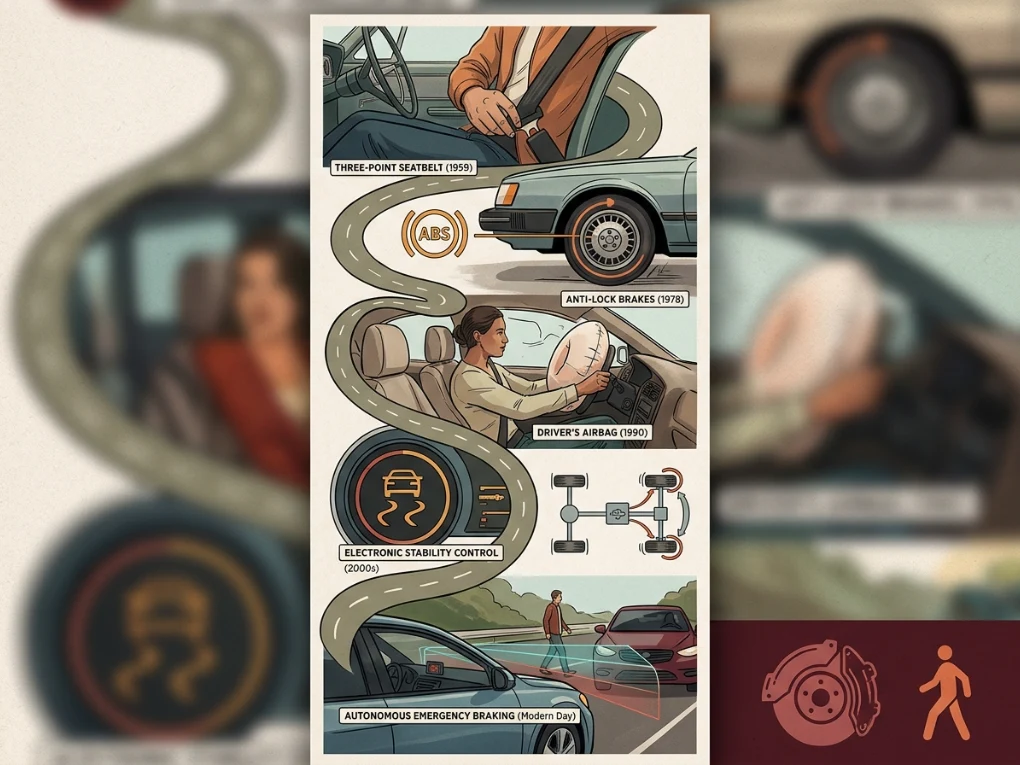
The history of car safety features by year highlights the steady shift from purely mechanical restraints to advanced digital automation.
| Year | Breakthrough Safety Technology | Impact on Automotive Passenger Safety |
| 1959 | Three-Point Seatbelt (Volvo) | Nils Bohlin patents the modern V-shaped 3-point seatbelt; open-sourced globally to save lives. |
| 1968 | First Commercial Automotive Airbag | Allen Breed invents the electromechanical sensor triggering airbag deployment within 30 milliseconds. |
| 1978 | Modern Multi-Channel ABS (Bosch/Mercedes-Benz) | Digital four-wheel ABS enters production, allowing full steering control under emergency braking. |
| 1995 | Electronic Stability Control (ESC) | Introduces yaw rate sensors and selective wheel braking to counter loss-of-control skids. |
| 1997 | ISOFIX Standardized Child Seat Anchorages | Standardizes rigid child car seat attachment points directly to the vehicle chassis structure. |
| 2003 | Pre-Collision Warning Systems | Front-mounted radar pre-tensions seatbelts and primes hydraulic brake boosters ahead of imminent impacts. |
| 2008 | City Autonomous Emergency Braking (City Safety) | Laser/radar-based AEB capable of stopping cars from low speeds without driver input. |
| 2014+ | Comprehensive Sensor Fusion & ADAS | Integrates camera, radar, and ultrasonic sensors to support Level 2 semi-autonomous highway driving. |
Child Car Seat Technology: Advanced Restraints and Biomechanics
Securing infants and young children requires specialized engineering beyond adult seatbelts. A child’s skull accounts for approximately 25% of their total body mass (compared to 6% in adults), while their neck vertebrae are soft and supported by underdeveloped ligaments.
       FRONTAL IMPACT COMPARISON: REAR-FACING VS. FORWARD-FACING

Rear-Facing Child Seat:
Force Direction:  <==== [Impact Force]
Seat Shell:       [==== Child Cradled in Rigid Shell ====>]
Load Distribution: Force spread evenly across entire back, neck, and head.
Cervical Strain:  Minimal (Kept within safe biomechanical thresholds)

Forward-Facing Child Seat:
Force Direction:  <==== [Impact Force]
Harness:          [== Harness Restrains Torso ==] ---> Head Throws Forward
Cervical Strain:  Severe load placed on delicate cervical spine and neck ligaments
The Physics of Extended Rear-Facing Travel
In a standard 50 km/h (31 mph) frontal crash, an infant seated forward-facing experiences tremendous neck load as their heavy head whips forward while their torso is restrained.
By contrast, an extended rear-facing child seat cradles the head, neck, and torso inside the protective shell of the seat. The deceleration force is distributed across the broad surface area of the child’s back. Biomechanical crash tests confirm that rear-facing seats reduce the risk of death and serious injury in frontal crashes by up to five times compared to forward-facing seats.
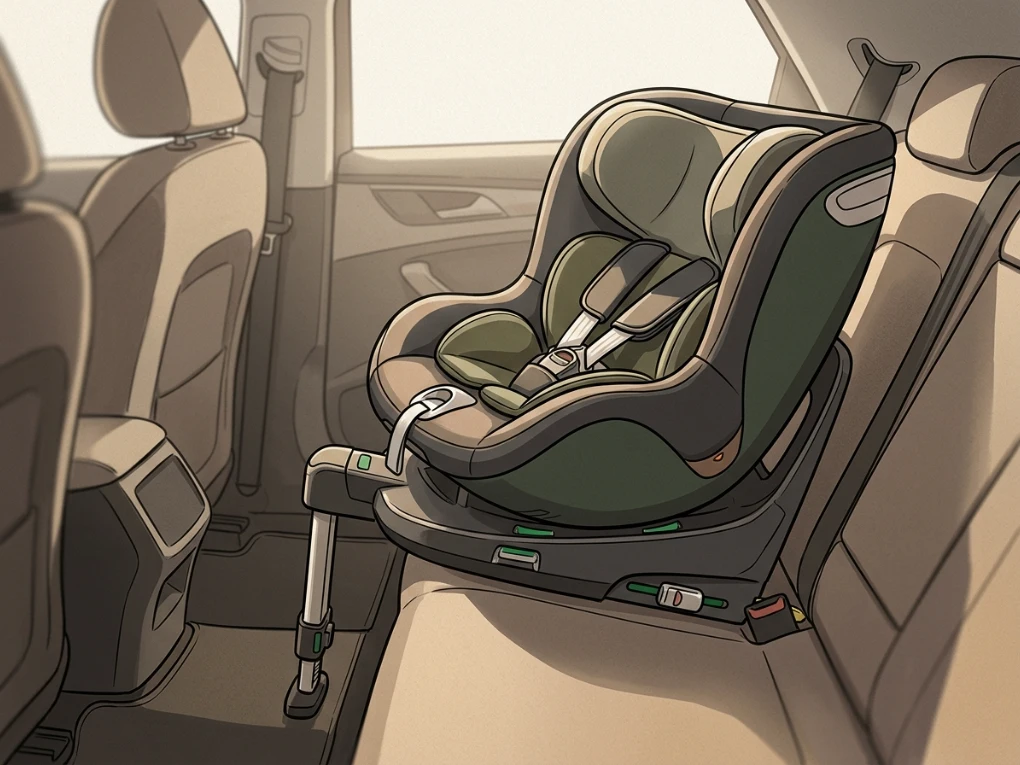
ISOFIX / LATCH Systems and Stability Legs
- Rigid Chassis Anchors: Eliminates installation errors common with seatbelt-secured child seats by clipping directly into dedicated welded steel chassis loops.
- Support Leg (Load Leg): Extends from the base of the child car seat to the vehicle floorpan. It absorbs downward pitch rotational energy during a frontal impact, stabilizing the seat.
- Top Tether: An upper anti-rotation strap used in forward-facing configurations to anchor the top of the car seat to a reinforced deck or seatback anchor.
i-Size (UN Regulation R129) Standards
The internationally recognized i-Size standard categorizes child seats by a child’s standing height (stature in cm) rather than weight. It mandates mandatory rear-facing transport until at least 15 months of age and requires rigorous dynamic side-impact crash testing using advanced Q-series sensor crash test dummies.
Vehicle Safety Technology (VST) Meets Defensive Roadcraft
Advanced vehicle safety technology (VST) provides powerful safety margins, but it cannot override the fundamental laws of friction and physics. The most effective safety strategy combines automated onboard systems with the principles of defensive roadcraft.
                           THE ACCIDENT PREVENTION TRIANGLE
                                          ▲
                                         / \
                                        /   \
                                       /     \
                                      /   ●   \
                                     / Vehicle \
                                    /  Safety   \
                                   / Technology  \
                                  /    (VST)      \
                                 /                 \
                                /═══════════════════\
                               /  Driver Roadcraft   \
                              /  & Situational Aware  \
                             /═════════════════════════\
                            / Environmental Traction &  \
                           /   Tire Friction Limits      \
                          ▲───────────────────────────────▲
Avoiding the Pitfalls of Risk Compensation
Psychologists and safety researchers frequently observe risk compensation theory (the Peltzman effect): when drivers feel protected by advanced safety suites, they may unconsciously take greater risks—such as tailgating closer, driving faster in rain, or glancing at mobile devices.
Integrating Technology with Defensive Driving
To maximize on-road safety:
- Maintain the Two-to-Three Second Rule: Never rely on Adaptive Cruise Control or AEB to manage safe stopping cushions behind heavy vehicles.
- Understand System Edge Cases: Forward-facing cameras can be blinded by low-angle sun glare, heavy downpours, thick fog, or road salt deposits over lenses.
- Prioritize Tire Maintenance: All braking systems (ABS, AEB, ESC) depend entirely on four small tire contact patches. Low tread depth or incorrect tire pressures degrade safety system efficacy.
- Use ADAS as a Backup, Not an Autopilot: Modern Level 1 and Level 2 driver-assist systems are supervisory aids designed to catch human errors, not fully autonomous driving replacements.
The Car Safety Technology Price Debate: Luxury vs. Standard Equipment
A central point of discussion across the global automotive market is the car safety technology price debate: Should life-saving automotive safety technology be offered as standard equipment on entry-level models, or is it fair for manufacturers to package these features into expensive optional packages?
+-----------------------------------------------------------------------------------+
|                        THE SAFETY PRICING DEBATE SPECTRUM                         |
+-----------------------------------------+-----------------------------------------+
|     ARGUMENT: UNIVERSAL STANDARD        |     ARGUMENT: MARKET TIER PRICING       |
+-----------------------------------------+-----------------------------------------+
| • Safety is a fundamental human right   | • Premium trims fund steep R&D costs    |
| • Crash reduction creates public savings| • Hardware & microchips raise base MSRP |
| • Fleet-wide rollout speeds vision zero | • Budget buyers need accessible options |
| • Mass production lowers sensor costs   | • Buyer choice drives healthy market    |
+-----------------------------------------+-----------------------------------------+
The Argument for Mandatory Standard Inclusions
Advocacy organizations like Euro NCAP, the IIHS (Insurance Institute for Highway Safety), and consumer rights groups argue that critical technologies like AEB, blind-spot monitoring, and lane-keep assist should never be restricted to top-tier luxury trims.
When life-saving tech is democratized across budget city cars and commuter sedans:
- Overall traffic collision frequency falls across communities.
- First-time drivers and younger motorists (the highest collision-risk demographic) benefit from safety margins.
- Societal costs associated with emergency services, hospitalizations, and lost economic productivity decline.
The Automaker and Manufacturing Perspective
From a manufacturing standpoint, integrating redundant sensor arrays, automotive-grade microprocessors, and complex camera suites adds bill-of-materials (BOM) costs to each vehicle. For low-margin, high-volume economy models, adding advanced ADAS hardware can push the entry MSRP beyond reach for budget-conscious buyers.
Automakers often use premium trim packages to offset substantial upfront research, development, and software calibration expenditures before scaling those systems across high-volume model lineups.
Level 0 to Level 5 Autonomous Driving Capabilities
Understanding modern vehicle safety requires familiarity with the SAE (Society of Automotive Engineers) levels of driving automation:
[Level 0] ──> [Level 1] ──> [Level 2] ──> [Level 3] ──> [Level 4] ──> [Level 5]
  Manual       Assisted     Partial Auto    Conditional     High Auto     Full Auto
(Warnings)    (Hands On)     (Hands On)     (Traffic Jam)  (Geofenced)  (Anywhere)
| SAE Level | Automation Level | Driver Involvement Required | Practical Real-World Feature Examples |
| Level 0 | No Automation | Driver performs all steering, braking, and throttle actions continuously. | Passive warnings: Blind Spot Chimes, Lane Departure alerts, ABS. |
| Level 1 | Driver Assistance | Driver performs all driving; vehicle assists with either steering or speed. | Adaptive Cruise Control OR Lane Centering (single-axis control). |
| Level 2 | Partial Automation | Driver must monitor road at all times and keep hands on the wheel. | Highway Assists (Tesla Autopilot, Ford BlueCruise, GM Super Cruise). |
| Level 3 | Conditional Automation | System handles all driving in specific settings; driver must take over if prompted. | Mercedes-Benz Drive Pilot (certified highway traffic jam assist up to speed limits). |
| Level 4 | High Automation | Vehicle manages all safety and operations in geo-fenced operating domains. | Autonomous Robotaxis operating in mapped metropolitan zones (e.g., Waymo). |
| Level 5 | Full Automation | Vehicle operates fully autonomously under all road conditions and global environments. | Fully driverless vehicles without steering wheels or foot pedals (future concept). |
What to Look for When Buying: Safety Feature Checklist
When shopping for a new or used family vehicle, use this prioritized checklist to ensure you obtain maximum protection:
                       SAFETY SHOPPING PRIORITY MATRIX

  [Must-Have Standards]            [Highly Recommended]            [Premium / Emerging]
  ─────────────────────            ────────────────────            ────────────────────
  ✓ Euro NCAP / IIHS 5-Star Rating  ✓ Blind Spot Monitoring (BSM)   ✓ Driver Monitoring (DMS)
  ✓ Low/High Speed AEB             ✓ Rear Cross-Traffic Alert      ✓ Matrix Adaptive LED
  ✓ 6+ Airbags (inc. Side Curtain) ✓ Lane Keep Assist (LKA)        ✓ Center/Knee Airbags
  ✓ Stability Control & ABS        ✓ 360-Degree Camera Views       ✓ Level 2+ Highway Pilot
- Official Safety Ratings: Look for top-tier scores from independent testing bodies—such as an IIHS Top Safety Pick+ (USA) or a 5-Star Euro NCAP rating.
- Essential Active Systems: Ensure the vehicle includes Automatic Emergency Braking (with pedestrian and cyclist detection) and Blind Spot Monitoring as standard.
- Restraint Hardware: Check for ISOFIX/LATCH anchors that are easily accessible with clear indicator guides, and look for vehicles with rear-seatbelt pre-tensioners and side curtain airbags that extend through all passenger rows.
Frequently Asked Questions (FAQ)
What is the single most important car safety technology ever invented?
The three-point seatbelt, patented by Volvo engineer Nils Bohlin in 1959, remains the most effective life-saving automotive safety feature in history. Regulatory and highway administration studies credit the three-point seatbelt with saving over one million lives worldwide since its introduction.
How do crumple zones protect passengers in a car crash?
Crumple zones deform progressively during an impact, absorbing kinetic energy and lengthening the duration of the crash deceleration ($\Delta t$). By extending the impact time, the peak impact force ($F$) acting on the vehicle structure and human occupants is significantly reduced ($F = \frac{\Delta p}{\Delta t}$).
Why are rear-facing child car seats safer for infants and toddlers?
In a frontal collision, a rear-facing seat supports the infant’s heavy head, neck, and spine against the rigid back of the safety seat, spreading deceleration forces evenly across the entire back. This prevents severe cervical spine hyperextension and reduces serious injury risk by up to 80% compared to forward-facing setups.
Can active car safety technology prevent all vehicle collisions?
No. While active systems like Autonomous Emergency Braking (AEB) and Electronic Stability Control (ESC) prevent countless crashes, they cannot overcome extreme conditions, excessive speeding, heavy ice, worn tire tread, or poor driver visibility. Active technology works best alongside attentive, defensive driving habits.
What is the difference between AEB and Forward Collision Warning?
Forward Collision Warning (FCW) only alerts the driver (via sound, visual cues, or haptic steering vibrations) that a collision is imminent. Automatic Emergency Braking (AEB) actively applies the vehicle’s hydraulic brakes to slow down or stop the car if the driver does not react in time.
Modern car safety technology has changed the automotive landscape, combining crumple zone physics, passive restraint engineering, and active ADAS sensors into an integrated system designed to protect lives on every journey. When choosing your next vehicle, prioritize proven structural safety ratings and essential active collision avoidance systems over superficial cosmetic upgrades.