
The automotive landscape has reached a decisive turning point. With more than one in four new passenger vehicles sold globally running on electric power, electric vehicles (EVs) are no longer a niche curiosity or an experimental technology. They are rapidly becoming the global standard for personal and commercial transport.
Whether your motivation stems from cutting fuel expenses, reducing your carbon footprint, or experiencing the smooth, instant torque of modern electric drivetrains, making the switch requires practical knowledge. This comprehensive electric cars guide breaks down how electric vehicles work, how to charge them efficiently, how much they cost to run, and which models deliver the best real-world performance today.
Understanding EV Terminology: BEV, PHEV, HEV, and FCEV
Before looking at specific models, it is essential to understand the four primary types of electrified powertrains. Not all cars with a battery operate the same way.
+-------------------------------------------------------------------------+
|                        ELECTRIFIED VEHICLE TYPES                        |
+---------------------+---------------------+-----------------------------+
|  BEV (All-Electric) |  PHEV (Plug-In)     |  HEV (Self-Charging)        |
|  - 100% Battery     |  - Gas + Battery    |  - Gas Engine + Small Motor |
|  - Zero Emissions   |  - Plugs In         |  - Cannot Plug In           |
|  - 250-600 km range |  - 40-80 km EV mode |  - Reduces fuel use slightly|
+---------------------+---------------------+-----------------------------+
Battery Electric Vehicles (BEV)
BEVs are 100% electric. They feature no internal combustion engine, no exhaust system, and no liquid fuel tank. Power comes entirely from an onboard high-voltage lithium-ion (or lithium-iron-phosphate / LFP) battery pack, which drives one or more electric motors.
- Emissions: Zero direct tailpipe emissions.
- Refueling: Plug-in charging only (Home AC or Public DC fast chargers).
- Typical Range: 250 km to 650+ km per charge.
- Best For: Drivers looking to eliminate gasoline costs entirely and maximize maintenance savings.
Plug-in Hybrid Electric Vehicles (PHEV)
PHEVs combine a conventional petrol or diesel combustion engine with an electric motor and a medium-sized battery pack. You can charge the battery via a wall outlet to drive 40 to 80 km purely on electricity. Once the battery depletes, the petrol engine takes over automatically.
- Emissions: Low when charged regularly; standard hybrid levels on petrol power.
- Refueling: Liquid fuel and electrical plug-in charging.
- Typical EV Range: 40 km to 90 km in pure electric mode.
- Best For: Long-distance drivers who want zero-emission daily commutes without relying entirely on public charging infrastructure.
Hybrid Electric Vehicles (HEV / “Self-Charging Hybrids”)
Standard hybrids use an internal combustion engine supported by a small electric motor and an auxiliary battery (usually 1 kWh to 2 kWh). The battery cannot be plugged in; it charges strictly through regenerative braking and excess engine output.
- Emissions: Moderate (15% to 30% lower fuel consumption than conventional petrol cars).
- Refueling: Petrol or diesel only.
- Typical EV Range: 1 km to 2 km at low parking speeds.
- Best For: Urban drivers who lack dedicated home charging facilities and want better fuel economy.
Fuel Cell Electric Vehicles (FCEV)
FCEVs use compressed hydrogen gas fed into a fuel cell stack, which creates electricity via an electrochemical reaction to power an electric motor. The only byproduct from the tailpipe is pure water vapor.
- Emissions: Zero tailpipe emissions.
- Refueling: High-pressure hydrogen pump (3 to 5 minutes).
- Typical Range: 500 km to 650 km.
- Best For: Specific regions with established hydrogen infrastructure; largely confined to specialized fleets and limited retail markets.
Powertrain Comparison
| Metric | BEV (All-Electric) | PHEV (Plug-In Hybrid) | HEV (Standard Hybrid) | ICE (Petrol/Diesel) |
| Primary Energy Source | Grid Electricity | Electricity + Petrol | Petrol / Diesel | Petrol / Diesel |
| Tailpipe Emissions | 0 g/km | 20–50 g/km (weighted) | 90–120 g/km | 140–250+ g/km |
| Home Charging? | Yes | Yes | No | No |
| Brake Wear | Very Low (Regen) | Low (Regen) | Moderate | High |
| Moving Drivetrain Parts | ~20 | ~2,000+ | ~2,000+ | ~2,000+ |
| Oil Changes Required? | Never | Yes (Regular intervals) | Yes (Regular intervals) | Yes (Regular intervals) |
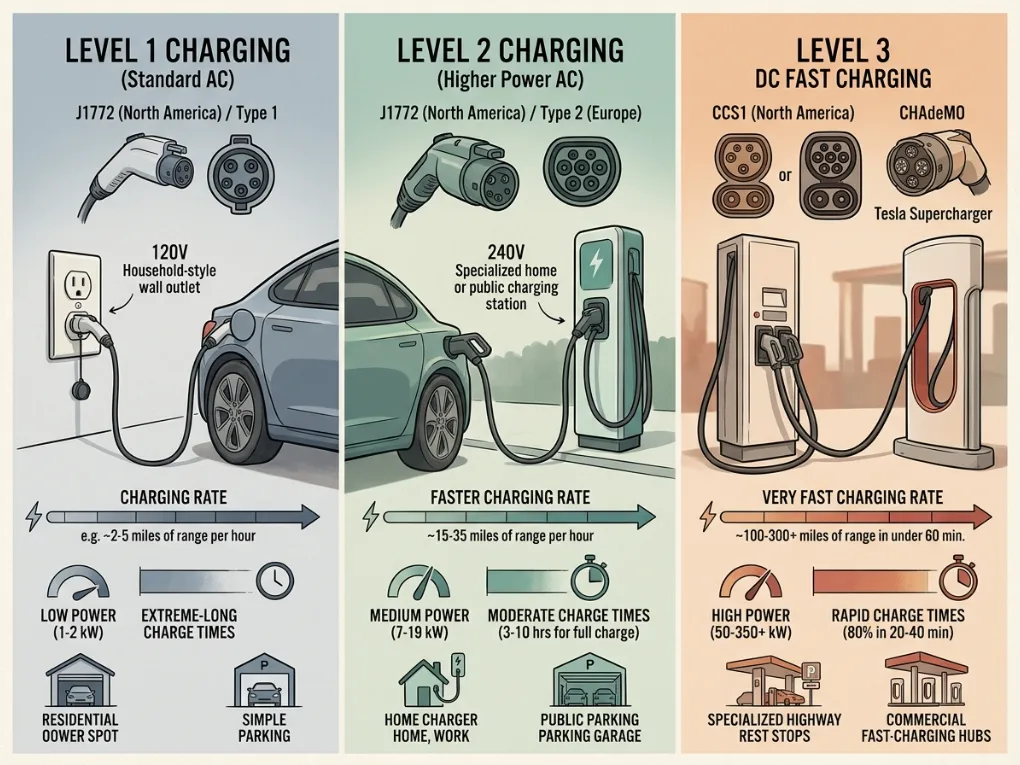
How EV Charging Works: Levels, Speeds, and Connectors
Charging an electric vehicle is fundamentally different from pumping petrol. Instead of visiting a service station once a week, EV charging operates on an “opportunistic” model: you charge where you park (at home, work, or public destinations) and rely on ultra-fast chargers during long road trips.
[Level 1: 1.4-2.4 kW] ---> [Level 2: 7-22 kW] ---> [Level 3 DC: 50-350 kW]
      Slow (Trickle)            Standard (Home/Work)          Ultra-Fast (En Route)
   10-15 km range / hr          40-100 km range / hr          200-300 km in 15-20 min
The Three Charging Levels
Level 1: Standard Domestic Socket (1.4 kW – 2.4 kW AC)
- Voltage / Amps: Standard 120V (North America) or 230V/10A household socket (UK, EU, AU, NZ, India).
- Speed: Adds roughly 10 km to 15 km of range per hour of charging.
- Best Use Case: Emergency top-ups, plug-in hybrids with small batteries, or low-mileage drivers traveling under 40 km per day.
Level 2: Dedicated AC Wallbox (7 kW – 22 kW AC)
- Voltage / Amps: 230V single-phase (32A) or 400V three-phase (16A/32A).
- Speed: Adds 40 km to 100 km of driving range per hour.
- Typical Full Charge: 6 to 9 hours for a completely depleted 60–80 kWh battery pack.
- Best Use Case: The primary charging solution for residential garages, apartment bays, and workplace car parks.
Level 3: DC Fast Charging & Ultra-Rapid Stations (50 kW – 350+ kW DC)
- Voltage: 400V to 800V direct current.
- Speed: Delivers up to 250 km to 350 km of driving range in 15 to 25 minutes.
- How it Works: Bypasses the car’s onboard AC inverter and pushes high-power direct current directly into the battery pack.
- Best Use Case: Highway rest stops, arterial travel corridors, and high-turnover commercial charging hubs.
International Charging Connector Standards
Different regions utilize distinct physical plugs for AC and DC charging. Modern BEVs manufactured for local markets come equipped with the standard plug corresponding to that geography:
- Type 2 (Mennekes): The universal AC charging plug across the UK, Europe, Australia, New Zealand, and India.
- CCS2 (Combined Charging System 2): Combines the Type 2 AC connector with two heavy-duty DC pins. The dominant standard for fast charging in Europe, UK, Australia, New Zealand, India, and Southeast Asia.
- NACS (North American Charging Standard / SAE J3400): Developed by Tesla and adopted across North America by major global automakers.
- CHAdeMO: Legacy Japanese DC fast-charging standard, now largely phased out on new models except for specific Japanese vehicles like the Nissan Leaf.
Battery Longevity, Chemistry, and Real-World Range
Range anxiety is one of the most common reservations among prospective EV drivers, but modern battery chemistry and thermal management have transformed daily reliability.
Battery Chemistries: NMC vs. LFP
Automakers primarily utilize two lithium-ion chemistries:
-
LFP (Lithium Iron Phosphate):
-
Strengths: Extremely durable, exceptional thermal stability, cobalt-free, and can be charged to 100% daily without degrading quickly.
-
Drawbacks: Lower energy density by weight, slightly slower charging in sub-zero winter temperatures.
-
Found in: Base Tesla Model 3/Y, BYD Atto 3 / Seal / Dolphin, MG4, standard-range commercial vehicles.
-
-
NMC (Nickel Manganese Cobalt):
-
Strengths: High energy density, lightweight, excellent cold-weather discharge rates.
-
Drawbacks: Higher manufacturing cost, sensitive to heat degradation if routinely kept at 100% state-of-charge (manufacturers recommend charging to 80% for daily use).
-
Found in: Long-range performance sedans, premium electric SUVs, heavy electric pickups.
-
Factors That Influence Real-World Range
The range figure displayed on a window sticker (tested under WLTP, EPA, or NEDC protocols) is an idealized benchmark. Real-world range fluctuates based on:
- Driving Speed: Electric motors operate at peak efficiency in stop-and-go city traffic due to regenerative braking. At high motorway speeds (110–130 km/h), aerodynamic drag increases exponentially, reducing range by 15% to 25%.
- Ambient Temperature: Freezing conditions slow down electrochemical reactions inside the battery and require energy to heat the cabin. Vehicles equipped with heat pumps retain significantly more winter efficiency than those with standard resistive heaters.
- Tire Pressure & Rolling Resistance: Under-inflated tires or aggressive winter treads increase resistance and draw more kilowatt-hours per 100 km.
- Payload and Towing: Carrying heavy cargo or pulling an aerodynamic trailer increases energy consumption substantially.
Comprehensive Electric Cars List: Top Models by Category
Selecting the right EV depends on your budget, family requirements, and daily driving distance. Below is a curated list of leading electric vehicles categorized by market segment.
+--------------------------------------------------------------------------+
|                       EV MARKET SEGMENT MATRIX                           |
+--------------------------------------------------------------------------+
|  Entry-Level / City  | MG4 Electric, BYD Dolphin, Renault 5 E-Tech       |
|  Family Crossovers   | Tesla Model Y, Hyundai Ioniq 5, Kia EV6, BYD Seal |
|  Long-Distance Exec  | Tesla Model 3 Long Range, BMW i4, Polestar 2      |
|  Luxury & Flagship   | Porsche Taycan, Mercedes-Benz EQE/EQS, Audi e-tron|
+--------------------------------------------------------------------------+
Best Compact & Budget-Friendly City Cars
- MG4 EV: Exceptional value, nimble rear-wheel-drive dynamics, and available with 51 kWh (LFP) up to 77 kWh (NMC) battery packs offering 350 km to 520 km WLTP range.
- BYD Dolphin: High standard safety equipment, spacious interior packaging, and standard durable Blade (LFP) battery technology.
- Fiat 500e / Renault 5 E-Tech: Stylish urban runabouts designed for tight city streets and low daily commutes with 200 km to 320 km of practical range.
Best Mid-Size Family SUVs & Crossovers
- Tesla Model Y: The world’s best-selling vehicle due to packaging efficiency, native access to the Supercharger network, minimal maintenance, and strong real-world efficiency.
- Hyundai Ioniq 5 & Kia EV6: Built on an advanced 800V architecture that allows DC fast-charging from 10% to 80% in just 18 minutes. Striking styling, Vehicle-to-Load (V2L) two-way power capabilities, and spacious interiors.
- Skoda Enyaq / Volkswagen ID.4: Practical, quiet, and comfort-tuned family cruisers offering 400 km to 540 km of range.
Best Long-Range Sedans & Executive Cars
- Tesla Model 3 (Long Range / Performance): Sets the benchmark for aerodynamic efficiency, boasting over 620 km WLTP range, class-leading software, and refined cabin acoustics.
- BMW i4: Combines classic BMW rear-wheel-drive steering dynamics and luxurious German interior build quality with a responsive 340 hp to 544 hp electric powertrain.
- BYD Seal: Premium design, standard structural Blade battery integration, sporty acceleration (0-100 km/h in 3.8s on AWD variants), and aggressive pricing.
Model Comparison Matrix
| Vehicle Model | Powertrain / Battery | WLTP Range | Max DC Fast Charge | 0–100 km/h (0–62 mph) | Key Target Buyer |
| MG4 Electric (Standard) | 51 kWh LFP (RWD) | 350 km | 88 kW | 7.7 sec | First-time EV buyer / City commuter |
| BYD Dolphin | 60.4 kWh LFP (FWD) | 427 km | 88 kW | 7.0 sec | Urban families & rideshare drivers |
| Tesla Model 3 RWD | 60 kWh LFP (RWD) | 513 km | 170 kW | 6.1 sec | Tech enthusiasts & commuters |
| Tesla Model Y Long Range | 78 kWh NMC (AWD) | 533 km | 250 kW | 5.0 sec | All-around family utility |
| Hyundai Ioniq 5 Long Range | 84 kWh NMC (RWD/AWD) | 570 km | 260 kW (800V) | 5.3 sec | Fast highway road-trippers |
| Kia EV6 Long Range | 84 kWh NMC (RWD) | 582 km | 260 kW (800V) | 7.3 sec | Design & tech-forward drivers |
| BMW i4 eDrive40 | 81.2 kWh NMC (RWD) | 590 km | 205 kW | 5.6 sec | Executive drivers / Highway cruisers |
| Porsche Taycan (Base) | 89 kWh Performance Plus | 678 km | 320 kW (800V) | 4.8 sec | Luxury performance enthusiasts |
Country-Specific EV Guidelines: Global Policies and Buying Landscapes
Government incentives, charging infrastructure maturity, and tax schemes vary widely by jurisdiction. Here is what drivers in major English-speaking and emerging markets need to know.
Electric Car Guide UK
- Market Overview: Electric car sales account for more than 20% of new registrations in the UK, supported by a dense network of motorway hubs (Gridserve, Ionity, InstaVolt).
- Incentives & Taxation: The central Plug-in Car Grant has ended for passenger vehicles, but company car drivers benefit from ultra-low Benefit-in-Kind (BiK) tax rates, making salary sacrifice schemes the most cost-effective method to acquire a new EV.
- Low Emission Zones: BEVs are 100% exempt from the London Congestion Charge and Ultra Low Emission Zone (ULEZ) charges, saving daily urban drivers thousands of pounds per year.
Electric Car Guide Australia
- Market Overview: EV adoption in Australia has expanded past 10% of new light vehicle sales, with popular models from BYD, Tesla, and MG leading the shift.
- Federal Incentives: The Electric Car Discount provides an exemption from Fringe Benefits Tax (FBT) on eligible zero- and low-emission vehicles provided through novated leases (under the Luxury Car Tax threshold).
- Charging Infrastructure: Major fast-charging networks like Chargefox, Evie Networks, and the NRMA National Network are linking regional corridors across the Hume, Pacific, and Bruce highways.
Electric Car Guide New Zealand
- Market Overview: New Zealand has an exceptionally high share of renewable electricity generation (>80%), making EVs an environmentally clean transportation choice.
- Road User Charges (RUC): Following the conclusion of temporary exemptions, electric light vehicles are subject to RUC per 1,000 kilometers driven, balancing road maintenance funding between fuel-taxed ICE vehicles and electrics.
- Used Import Market: A major feature of the NZ market is the availability of affordable imported Japanese electric cars (such as second-hand Nissan Leafs and e-NV200s) alongside brand-new models.
Electric Car Guide Ireland
-
Incentives: Sustainable Energy Authority of Ireland (SEAI) grants offer direct capital subsidies for private electric vehicle purchases up to eligible purchase thresholds.
-
Tax Relief: EVs benefit from the lowest Vehicle Registration Tax (VRT) bands and the minimum annual motor tax rate (€120/year). Home charging installation is supported by SEAI home charger installation grants.
Electric Cars List & Guide for India
- Market Dynamics: India’s passenger EV market is expanding rapidly, led by domestic giants Tata Motors and Mahindra alongside global contenders like MG and BYD.
- Top Electric Cars in India:
-
-
Tata Tiago EV / Punch EV: Highly accessible compact city hatchbacks and sub-compact SUVs with 250 km to 350 km MIDC range.
-
Tata Nexon EV: India’s most popular electric SUV, featuring 45 kWh battery options and robust ground clearance.
-
Mahindra XUV400: Spacious electric crossover with fast-charging support and aggressive pricing.
-
MG ZS EV & BYD Atto 3: Premium mid-size electric SUVs offering 400+ km of real-world highway range.
-
-
Tax Structure: EVs in India enjoy a reduced 5% GST rate (compared to 28%+ for internal combustion vehicles) and road tax exemptions across numerous progressive states (e.g., Maharashtra, Delhi, Karnataka).
Total Cost of Ownership: EV vs. Petrol
While the upfront sticker price of an electric vehicle can be higher than an equivalent petrol car, the Total Cost of Ownership (TCO) over 3 to 7 years is often significantly lower due to fuel and maintenance savings.
Estimated 5-Year Cost Breakdown (Based on 15,000 km / 10,000 miles per year)
-----------------------------------------------------------------------------
[Fuel / Energy]        ICE: $9,500   | EV (Home Charging): $2,400  (Save $7,100)
[Routine Maintenance]  ICE: $3,200   | EV (Brakes, Filters): $900  (Save $2,300)
[Brake Replacements]   ICE: $1,100   | EV (Regen Brakes): $250     (Save $850)
-----------------------------------------------------------------------------
ESTIMATED 5-YEAR OPERATING SAVINGS: ~$10,250
Fuel vs. Electricity Calculations
- Charging at Home: Electricity prices off-peak (such as overnight EV tariffs in the UK at 7p–9p/kWh or standard residential rates in AU/US/NZ) make home charging 70% to 80% cheaper per kilometer than buying petrol.
- Public Fast Charging: Ultra-rapid DC chargers are priced at commercial rates to account for infrastructure and demand charges. While still generally cheaper than premium petrol, frequent reliance on high-output DC charging narrows the operating cost advantage.
Maintenance & Wear Items
Electric drivetrains are mechanically simple. There are:
- No engine oil or oil filters to replace.
- No spark plugs, fuel injectors, timing belts, or oxygen sensors.
- No multi-gear automatic transmissions requiring clutch pack servicing.
- Significantly less brake wear: Because electric cars use regenerative braking to slow down by turning kinetic energy back into battery storage, physical brake pads and rotors can last well over 100,000 km.
Practical Electric Vehicle Guidelines for Drivers
To get the most out of your electric car, implement these operational best practices:
- Set an 80% Charge Limit for Daily Driving (NMC Packs): If your car uses an NMC battery, set the charge threshold to 80% for daily commutes to minimize chemical stress. Reserve 100% full charges for morning departures before long road trips. (LFP-equipped cars can safely charge to 100% regularly).
- Pre-Condition the Cabin While Plugged In: Use your car’s mobile app to warm or cool the cabin 15 minutes before leaving while the car is still connected to your home charger. This pulls energy from the electrical grid rather than depleting your battery on the road.
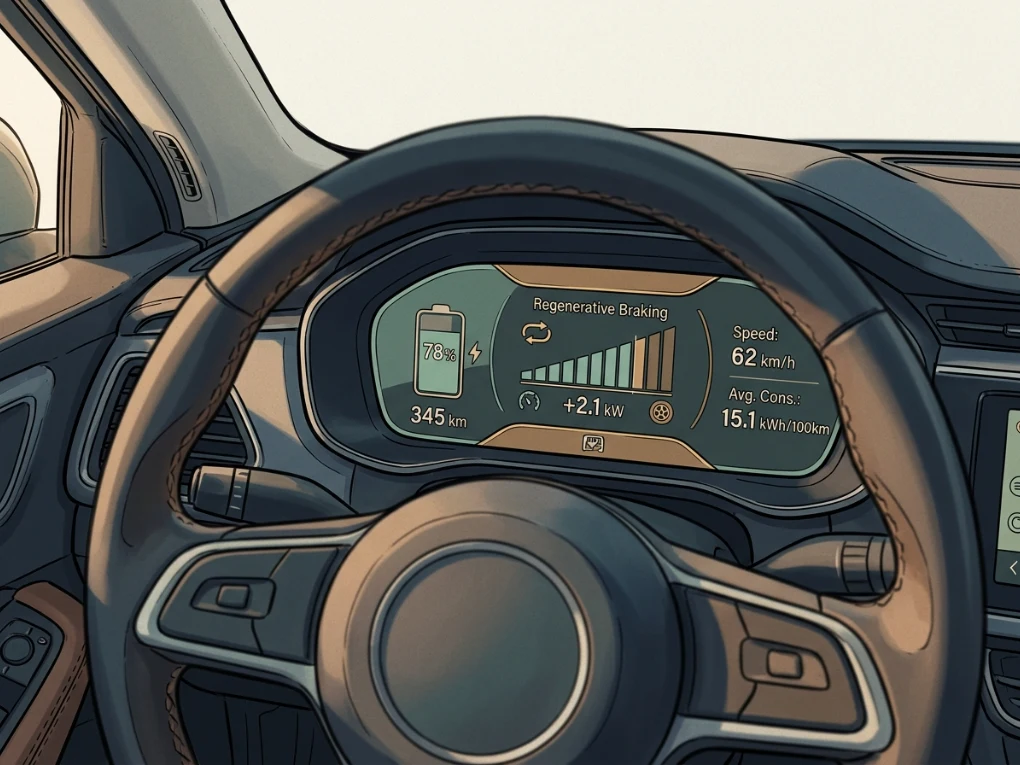
- Master One-Pedal Driving: Maximize regenerative braking by allowing the vehicle to slow itself down naturally when you lift off the accelerator. This smooths out urban driving and recovers up to 20% of kinetic energy back into the pack.
- Pre-Condition the Battery for DC Fast Charging: When navigating to an ultra-fast charger on a road trip, use the car’s built-in navigation system. Modern EVs will automatically warm or cool the battery to its optimal thermal window (typically 25°C to 35°C), cutting DC charge times in half.
- Maintain Proper Tire Inflation: Because EVs are heavier and deliver instant low-end torque, under-inflated tires will accelerate tread wear and reduce total range. Check tire pressures monthly.
Frequently Asked Questions (FAQ)
What happens if an electric car runs completely out of battery?
Modern EVs provide multiple visual warnings, audible alerts, and power limits (often called “turtle mode”) as the battery approaches 0%. If you ignore all warnings and the battery fully depletes, the vehicle will safely disengage drive and coast to a stop. You will need a mobile breakdown service equipped with a roadside fast charger or a flatbed tow truck to transport the vehicle to the nearest charging station.
How long do electric car batteries last before needing replacement?
Modern EV batteries are designed to last the life of the vehicle—typically 10 to 15+ years or 250,000 to 500,000 km. Most manufacturers provide dedicated battery warranties of 8 years or 160,000 km (100,000 miles), guaranteeing that the pack will retain at least 70% to 75% of its original storage capacity.
Can I charge an electric car in heavy rain?
Yes. EV charging systems and connectors are weatherproofed and engineered with safety interlocks. Electricity does not flow through the pins until the vehicle and the charging station complete an electronic handshake confirming a sealed, ground-safe connection.
How much does it cost to install a home Level 2 EV charger?
A standard 7 kW dedicated home wallbox charger typically costs between $500 and $1,200 (or £400–£900 / €600–€1,100 / ₹30,000–₹60,000) for the hardware, plus electrical installation labor depending on the distance between your main switchboard and parking location.
Is an EV right for me if I cannot charge at home?
Yes, but you should evaluate your local infrastructure first. If you have access to Level 2 chargers at your workplace, curbside public charging in your neighborhood, or nearby rapid chargers at supermarkets and shopping malls, owning an EV is entirely practical. If you must rely solely on expensive commercial DC fast chargers, your operating cost savings will be smaller.
Conclusion
Transitioning to an electric vehicle offers significant advantages: lower operating costs, instant acceleration, zero direct tailpipe emissions, and the convenience of starting every morning with a full “tank” right from your driveway.
As battery technology improves, charging networks densify, and lower-cost models enter the market, electric mobility is now the most practical long-term choice for private and commercial drivers alike.