
Choosing the right vehicle starts with understanding the wide variety of types of cars available on the market. From nimble urban hatchbacks and comfortable family sedans to rugged off-road SUVs and high-performance sports cars, modern automotive design offers configurations tailored to nearly every lifestyle, budget, and driving condition.
This comprehensive guide breaks down car body styles, popular brand names, regional market dynamics in countries like India and Kenya, and practical steps to choose the vehicle that fits your daily needs.
What Determines a Car’s Body Style?
Car classifications are primarily determined by three structural elements:
- Chassis Architecture: Whether the vehicle uses unibody construction (shared body and frame, common in sedans and crossovers) or body-on-frame construction (body mounted onto a rigid frame, typical of heavy-duty trucks and traditional SUVs).
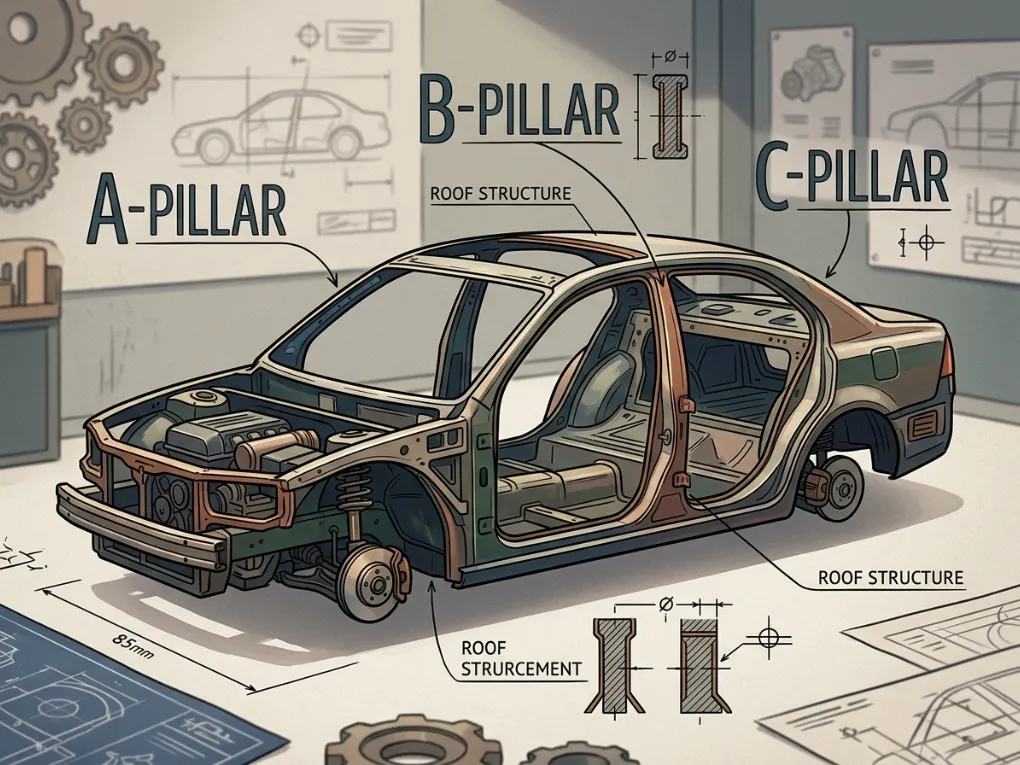
- Pillar Design: The vertical roof supports designated alphabetically from front to back:
-
-
A-pillars: Frame the windshield.
-
B-pillars: Positioned between the front and rear doors.
-
C-pillars: Frame the rear passenger window or rear windscreen.
-
D-pillars: Found in larger wagons and three-row SUVs.
-
-
Compartment Division: Vehicles are generally split into one-box (cargo/passenger combined, like vans), two-box (separate engine bay, combined cabin and cargo, like hatchbacks and SUVs), or three-box configurations (distinct engine bay, passenger cabin, and enclosed trunk, like sedans).
Complete Breakdown: Types of Cars by Body Style
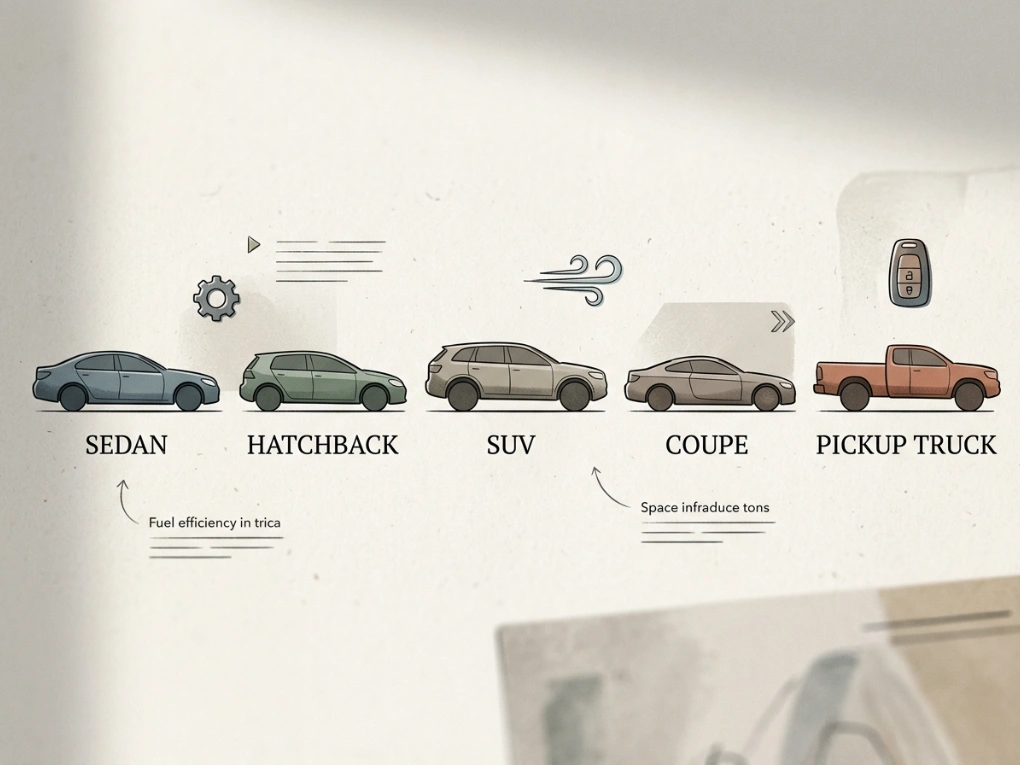
Understanding the distinct types of cars and their names helps buyers quickly filter through dealership inventories and online listings.
Sedans
Sedans feature a classic three-box configuration with separate compartments for the engine, passengers, and cargo. They typically have four doors and a fixed roof.
- Key Characteristics: Low center of gravity, enclosed locking trunk, four passenger doors.
- Pros: Balanced handling, strong fuel efficiency, secure cargo storage.
- Cons: Fixed cargo space, lower ground clearance compared to crossovers.
- Popular Models: Toyota Camry, Honda Accord, Hyundai Elantra, BMW 3 Series.
Hatchbacks
Hatchbacks are two-box vehicles featuring a rear door that swings upward to provide access to a flexible cargo area integrated with the passenger cabin.
- Key Characteristics: Compact exterior footprint, folding rear seats, vertical tailgate.
- Pros: Easy to park in tight city spaces, flexible cargo configuration, budget-friendly running costs.
- Cons: Reduced trunk privacy without a parcel shelf, slightly louder cabin acoustics from the open cargo area.
- Popular Models: Volkswagen Golf, Maruti Suzuki Swift, Honda Civic Hatchback, Hyundai i20.
SUVs (Sport Utility Vehicles)
SUVs combine passenger-carrying features with elements adapted from off-road vehicles, such as elevated ground clearance and available four-wheel drive (4WD) or all-wheel drive (AWD).
-
Sub-categories:
-
Compact SUVs / Subcompact Crossovers: Built on car platforms for urban agility (e.g., Hyundai Creta, Toyota RAV4).
-
Midsize SUVs: Offer two or three rows of seating with moderate towing capability (e.g., Ford Explorer, Toyota Highlander).
-
Full-Size Body-on-Frame SUVs: Built on truck platforms for extreme towing and off-road work (e.g., Toyota Land Cruiser, Chevrolet Tahoe).
-
- Pros: High driving position, confident all-weather traction, generous passenger and cargo capacity.
- Cons: Higher fuel consumption, increased rollover risk due to elevated center of gravity.
Crossovers (CUVs)
While often marketed under the SUV umbrella, crossovers are built on a car unibody platform rather than a truck frame. They provide the taller seating position of an SUV paired with the ride quality and fuel economy of a sedan.
- Pros: Smooth ride quality, better fuel economy than traditional truck-based SUVs.
- Cons: Moderate towing capacities, limited severe off-road capability.
- Popular Models: Subaru Outback, Mazda CX-5, Nissan Rogue.
Coupes
Traditionally, a coupe is a two-door car with a fixed roof and a sporty, sloping rear roofline. In recent years, automakers have also applied the term “four-door coupe” to sedans featuring aggressive, fastback roof profiles.
- Pros: Distinctive styling, optimized aerodynamics, engaging driving dynamics.
- Cons: Restricted rear-seat headroom and legroom, smaller trunk opening.
- Popular Models: Ford Mustang, BMW 4 Series Coupe, Audi A5.
Convertibles and Cabriolets
Convertibles feature retractable roof mechanisms—either fabric soft-tops or folding metal hard-tops—allowing drivers to switch between open-air and enclosed configurations.
- Pros: Open-air driving experience, classic aesthetics.
- Cons: Added curb weight from structural chassis bracing, reduced cargo space when the roof is retracted.
- Popular Models: Mazda MX-5 Miata, Porsche 911 Cabriolet, Mini Cooper Convertible.
Station Wagons (Estates)
Station wagons share the unibody platform and driving dynamics of sedans, but feature an extended roofline that stretches to the rear of the vehicle, creating a large, enclosed cargo hold accessible via a tailgate.
- Pros: Sedan-like handling and fuel efficiency paired with SUV-rivaling cargo space.
- Cons: Less popular in certain markets, leading to fewer new model choices.
- Popular Models: Volvo V60/V90, Audi A6 Avant, Subaru Outback (wagon/crossover hybrid).
Minivans and MPVs (Multi-Purpose Vehicles)
Minivans prioritize interior passenger room, cargo versatility, and practical access. Most feature sliding side doors, flat cabin floors, and reconfigurable three-row seating.
- Pros: Unmatched passenger accessibility, cavernous cargo volume, child-friendly interior layouts.
- Cons: Functional appearance, larger physical footprint for tight parking spots.
- Popular Models: Toyota Sienna, Honda Odyssey, Kia Carnival, Toyota Innova.
Pickup Trucks
Pickup trucks feature an enclosed passenger cab attached to an open rear cargo bed with low sides and a tailgate. They are built for payload capacity, towing, and rough terrain.
- Cab Configurations: Regular Cab (2 doors), Extended Cab (small rear doors), Crew Cab (4 full-sized doors).
- Pros: High payload and towing ratings, robust ladder-frame chassis.
- Cons: Stiffer ride when unloaded, greater vehicle length.
- Popular Models: Ford F-150, Toyota Hilux, Isuzu D-Max.
Comparison Table: Vehicle Body Styles at a Glance
| Body Style | Typical Seating | Cargo Flexibility | Ground Clearance | Fuel Economy | Best Suited For |
| Sedan | 5 Passengers | Moderate | Low (130–165 mm) | High | Daily commuters, highway travelers |
| Hatchback | 4–5 Passengers | High (Folding seats) | Low to Medium | Very High | City driving, tight parking, budget buyers |
| SUV | 5–8 Passengers | High | High (180–230+ mm) | Moderate | Families, mixed road conditions, towing |
| Crossover | 5 Passengers | High | Medium to High | High to Moderate | Suburban commutes, active lifestyles |
| Coupe | 2–4 Passengers | Low | Low | Moderate | Enthusiasts, weekend drivers |
| Convertible | 2–4 Passengers | Low | Low | Moderate | Recreational driving, warm climates |
| Station Wagon | 5 Passengers | Very High | Low to Medium | High | Long road trips, practical hauling |
| Minivan/MPV | 7–8 Passengers | Maximum | Low to Medium | Moderate | Large families, group passenger transport |
| Pickup Truck | 2–5 Passengers | Maximum (Open bed) | High | Moderate to Low | Heavy hauling, worksites, rural routes |
Types of Cars by Fuel and Powertrain Technology
Beyond external shapes, vehicles are classified by the mechanical systems that propel them:
Automotive Powertrains
 ├── Internal Combustion Engine (ICE)
 │    ├── Petrol / Gasoline
 │    └── Diesel
 ├── Hybrid Systems
 │    ├── Mild Hybrid (MHEV)
 │    ├── Full Hybrid (HEV)
 │    └── Plug-in Hybrid (PHEV)
 └── Zero-Emission
      ├── Battery Electric Vehicle (BEV)
      └── Fuel Cell Electric Vehicle (FCEV - Hydrogen)
- Internal Combustion Engine (ICE): Runs on petrol or diesel. Provides widespread fueling infrastructure and predictable long-distance range.
- Hybrid Electric Vehicles (HEV): Pairs a petrol engine with an electric motor and self-charging battery to recapture braking energy and reduce fuel consumption.
- Plug-in Hybrid Electric Vehicles (PHEV): Features a larger battery pack that can be charged from a wall outlet, offering 30 to 80 km of pure-electric driving before switching to petrol mode.
-
Battery Electric Vehicles (BEV): Runs entirely on electric motors powered by rechargeable high-voltage lithium-ion or LFP battery packs, producing zero direct tailpipe emissions.
An A-to-Z Directory of Major Car Brands and Core Models
When browsing types of cars brands and their hallmark nameplates, this quick-reference directory outlines leading manufacturers:
- Audi: Known for Quattro all-wheel drive, luxury sedans (A4, A6), and executive SUVs (Q5, Q7).
- BMW: Renowned for balanced rear-wheel-drive dynamics, performance sedans (3 Series, 5 Series), and sport-activity vehicles (X3, X5).
- Chevrolet: Offers versatile pickup trucks (Silverado), large SUVs (Tahoe, Suburban), and performance icons (Corvette).
- Ford: Specializes in durable trucks (F-150, Ranger), pony cars (Mustang), and commercial vans (Transit).
- Honda: Respected for engineering reliability and space-efficient designs (Civic, Accord, CR-V).
- Hyundai: Offers advanced technology integration and value-packed styling (i20, Elantra, Tucson, Ioniq 5).
- Isuzu: Specializes in robust diesel utility platforms and commercial haulers (D-Max, MU-X).
- Kia: Known for bold vehicle design, family practicality, and long warranties (Seltos, Sportage, EV6).
- Mercedes-Benz: Sets industry standards in automotive safety and luxury flagships (C-Class, E-Class, S-Class, G-Class).
- Nissan: Delivers accessible crossovers and utility vehicles (Qashqai, X-Trail, Navara).
- Porsche: High-end sports cars and performance SUVs (911, 718 Cayman, Macan, Cayenne).
- Subaru: Symmetrical all-wheel drive and boxer engines standard across utility models (Forester, Outback, Crosstrek).
- Tata Motors: An Indian engineering powerhouse leading in structural safety and EV adoption (Nexon, Harrier, Punch).
- Toyota: The world’s largest automotive manufacturer by volume, renowned for bulletproof reliability and hybrid systems (Corolla, Camry, RAV4, Hilux, Land Cruiser).
- Volkswagen: Precision German engineering across compact, family, and EV lineups (Polo, Golf, Tiguan, ID.4).
- Volvo: Pioneer in vehicle safety systems and modern Scandinavian interior design (XC40, XC60, XC90).
Regional Market Spotlights
Consumer vehicle preferences vary dramatically based on local infrastructure, fuel taxation, import regulations, and road conditions.
Types of Cars in India
The Indian automotive landscape is driven by practical compactness, high fuel efficiency, ground clearance for monsoon conditions, and structural safety ratings (Bharat NCAP).
- Dominant Body Styles: Sub-4-meter compact SUVs, premium hatchbacks, and 7-seater MPVs.
- Market Leaders: Maruti Suzuki, Hyundai, Tata Motors, Mahindra & Mahindra, and Toyota.
- Popular Models: Maruti Suzuki Baleno/Brezzza, Tata Nexon/Punch, Hyundai Creta, Mahindra Scorpio-N/XUV700, and Toyota Innova Crysta/Hycross.
- Key Consideration: Cars under 4 meters in length with smaller engine displacements receive favorable excise duty classifications in India, making compact sub-4m SUVs exceptionally popular.
Types of Cars in Kenya & East Africa (Uganda)
In Kenya and Uganda, the market is heavily shaped by imported pre-owned vehicles (primarily Japanese Domestic Market imports via Mombasa Port), rugged durability requirements, and spare parts availability.
- Dominant Body Styles: Compact crossovers, mid-size diesel SUVs, 4WD station wagons, and commercial pickups.
- Market Leaders: Toyota, Subaru, Isuzu, Nissan, and Mazda.
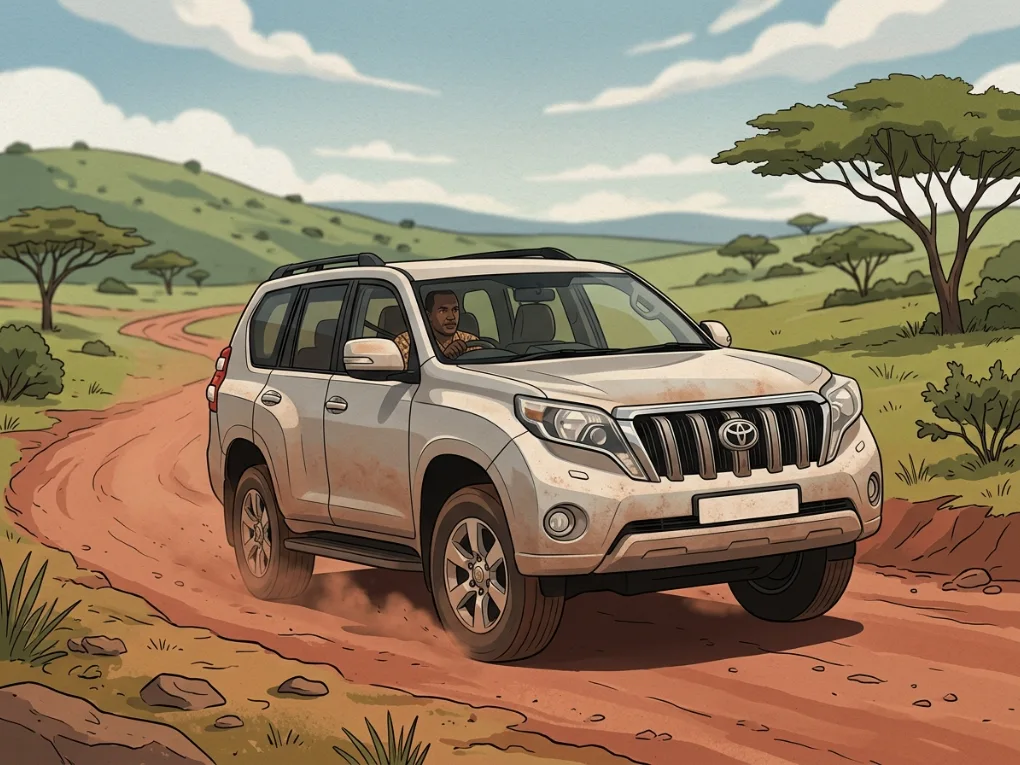
- Popular Models in Kenya & Uganda: Toyota Premio, Toyota Fielder, Toyota Land Cruiser Prado, Subaru Forester, Mazda Demio, and Isuzu D-Max.
- Price Dynamics in Kenya:
-
-
Compact Hatchbacks (e.g., Toyota Vitz, Mazda Demio): KSh 900,000 – KSh 1,600,000
-
Mid-Size Station Wagons & Sedans (e.g., Toyota Fielder, Premio): KSh 1,500,000 – KSh 2,500,000
-
Crossovers & Mid SUVs (e.g., Subaru Forester, Toyota RAV4): KSh 2,400,000 – KSh 4,200,000
-
Heavy-Duty 4WDs (e.g., Toyota Prado TX, Land Cruiser 200/300): KSh 5,000,000 – KSh 14,000,000+
-
Pop Culture Focus: Types of Cars in the “Cars” Movie
The Pixar Cars franchise provides a creative lens into car taxonomy by basing its animated characters on real-world automotive icons:
- Lightning McQueen: A custom-built NASCAR/Le Mans hybrid racer inspired by the Chevrolet Corvette C6 and Lola T70.
- Tow Mater: A 1951 International Harvester L-170 boom truck with elements of a Chevrolet task-force truck.
- Doc Hudson (The Fabulous Hudson Hornet): A 1951 Hudson Hornet dual H-power stock car.
- Sally Carrera: A 2002 Porsche 911 Carrera (996 generation).
- Luigi: A classic 1959 Fiat 500 city car.
- Fillmore: A 1960 Volkswagen Type 2 Microbus.
Step-by-Step Guide: How to Choose the Right Car
- Assess Your Typical Occupancy: If you carry 1–2 people daily, a hatchback, sedan, or compact crossover minimizes fuel waste. For families of 5 or more, look at 3-row SUVs or MPVs.
- Evaluate Road & Weather Conditions: Frequent gravel roads, potholes, or heavy seasonal rains warrant ground clearance of at least 180 mm and all-wheel drive.
- Calculate Total Cost of Ownership (TCO): Look beyond the purchase price. Factor in depreciation, insurance rates, fuel economy, service intervals, and local spare parts availability.
- Test the Ergonomics: Always evaluate seat support, blind-spot visibility, infotainment usability, and ease of loading the cargo area before making a purchase decision.
Frequently Asked Questions (FAQs)
What is the most popular type of car worldwide?
Compact crossovers and SUVs currently represent the fastest-growing and largest market share globally, favored for their elevated driving position, versatile interior storage, and safety profile.
What is the main difference between a sedan and a hatchback?
A sedan has a distinct, fully enclosed three-box trunk separated from the cabin. A hatchback features a two-box design where the rear cargo door hinges at roof level, opening into the passenger compartment with folding rear seats for flexible storage.
Which car type offers the best fuel economy?
Excluding fully electric vehicles, hybrid hatchbacks and aerodynamic compact sedans offer the highest fuel economy ratings due to low curb weight, regenerative braking, and reduced aerodynamic drag.
What is the difference between an SUV and a Crossover?
An SUV is traditionally built using body-on-frame truck construction, designed for heavy towing and off-road driving. A Crossover (CUV) is built on a lighter car unibody frame, emphasizing ride comfort, responsive handling, and fuel efficiency.
Conclusion
Finding the ideal vehicle comes down to balancing passenger capacity, road conditions, fuel efficiency, and long-term ownership costs. Whether you need the parking convenience of a hatchback, the versatility of an SUV, or the towing capability of a pickup truck, understanding car classifications helps you buy with complete confidence.
Ready to find your next ride? Explore our detailed model comparison tools, schedule a test drive at your local certified dealership, and download our pre-purchase vehicle inspection checklist today!