Coursera is better for accredited career credentials and university-backed degrees, while Udemy is superior for budget-friendly, immediate practical skill acquisition. Choosing between Coursera vs Udemy depends entirely on whether you need formal career accreditation or fast, task-oriented software training. Coursera partners with institutions like Stanford and Google to deliver structured multi-month programs.
In contrast, Udemy operates an open marketplace offering over 210,000 self-paced courses with lifetime access. This hands-on breakdown analyzes pricing, certificate value, and course quality to maximize your educational return on investment.
Quick Summary
- Primary Model: Coursera operates an accredited institutional catalog; Udemy runs an open creator marketplace.
- Pricing: Coursera relies on subscriptions ($49–$79/month or $399/year); Udemy focuses on discounted individual purchases ($12.99–$29.99 lifetime access).
- Employer Recognition: Coursera Professional Certificates pass corporate ATS screeners for junior roles; Udemy certificates serve purely as personal proof of curiosity.
- AI Integration: Coursera uses interactive in-course AI coaches trained on validated curricula; Udemy deploys automated Q&A summaries and code-fixing aids.
- Best For: Coursera wins for career switchers seeking formal credentials; Udemy wins for developers needing on-demand, tactical problem-solving.
Coursera vs Udemy at a Glance: Key Differences
The Coursera vs Udemy debate centers on two opposing online learning architectures: Coursera is an institutionally curated academy offering accredited corporate and university credentials, whereas Udemy is a decentralized open marketplace where independent instructors publish self-paced tactical tutorials.
Your choice maps directly to your learning intent. Career switchers requiring multi-month accountability, proctored exams, and recruiter-recognized credentials should prioritize Coursera. Professionals who need to fix a specific bug, learn a new framework over a weekend, or pick up a creative hobby should turn to Udemy.
| Comparison Metric | Coursera | Udemy |
| Platform Model | Curated institutional catalog | Open creator marketplace |
| Catalog Size | ~7,000+ courses; 100+ degrees & certificates | ~210,000+ courses |
| Pricing Structure | Free audit; $49–$79/month; $399/year (Plus) | Single purchases ($12.99–$29.99 on sale); $30/month (Personal Plan) |
| Access Model | Subscription duration or fixed degree cohort | Lifetime access per individual purchase |
| Accreditation & Credit | ACE-recommended credits; accredited university degrees | Non-accredited; proprietary completion badges |
| Instructor Types | University professors, tech leaders (Google, IBM, Meta) | Freelancers, industry practitioners, independent developers |
| Refund Policy | 14-day subscription refund; 7-day free trial | 30-day money-back guarantee across all purchases |
| Best For | Career pivoting, formal qualifications, university paths | Immediate skill fixes, niche tools, tactical problem-solving |
Pricing and Subscription Models: Which Offers Better ROI?
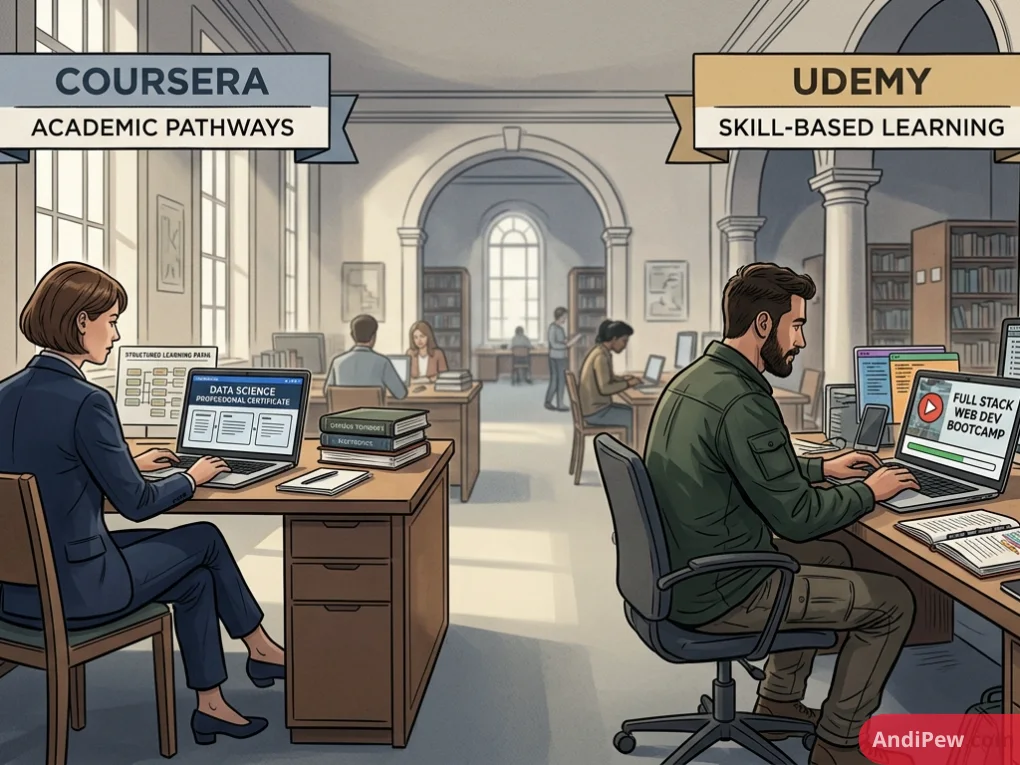
Udemy delivers superior financial return on investment for sprint learners targeting single skills, while Coursera provides better ROI for intensive learners pursuing multi-course career specializations within a condensed calendar window.
Direct Cost Comparison
- Udemy Single Purchase: Courses list for $84.99–$199.99, but site-wide sales run multiple times per month, dropping prices to $12.99–$29.99 with lifetime access.
- Udemy Personal Plan: A subscription tier priced at $30 per month providing access to an audited subset of ~10,500 top-rated courses.
- Coursera Specializations: Billed at $49–$79 per month until completion, meaning your final cost directly mirrors your completion speed.
- Coursera Plus: Billed at $59 per month or $399 per year, unlocking unlimited access to more than 7,000 courses, Specializations, and Professional Certificates.
- Coursera Financial Aid: Learners can apply for institutional tuition assistance, which regularly covers 75% to 90% of certificate enrollment fees for qualifying applicants.
Scenario Breakdown: Sprint Learner vs. Career Builder
The financial break-even calculation hinges entirely on your weekly time commitment:
- The Sprint Learner (Udemy Advantage): A front-end developer needs to master Tailwind CSS syntax over a weekend. Purchasing a targeted Udemy course for $14.99 yields lifetime access, updates, and zero recurring billing pressure. Buying a Coursera subscription for a single narrow tool represents a negative return on investment.
- The Career Builder (Coursera Advantage): A career changer completing the Google Data Analytics Professional Certificate requires approximately 180 hours of coursework. Finishing the program within 3 months at $49 per month costs $147 total—delivering an ACE-accredited industry credential, employer job consortium access, and proctored capstone verification.
Course Quality and Instructor Credibility: How Are Courses Vetted?
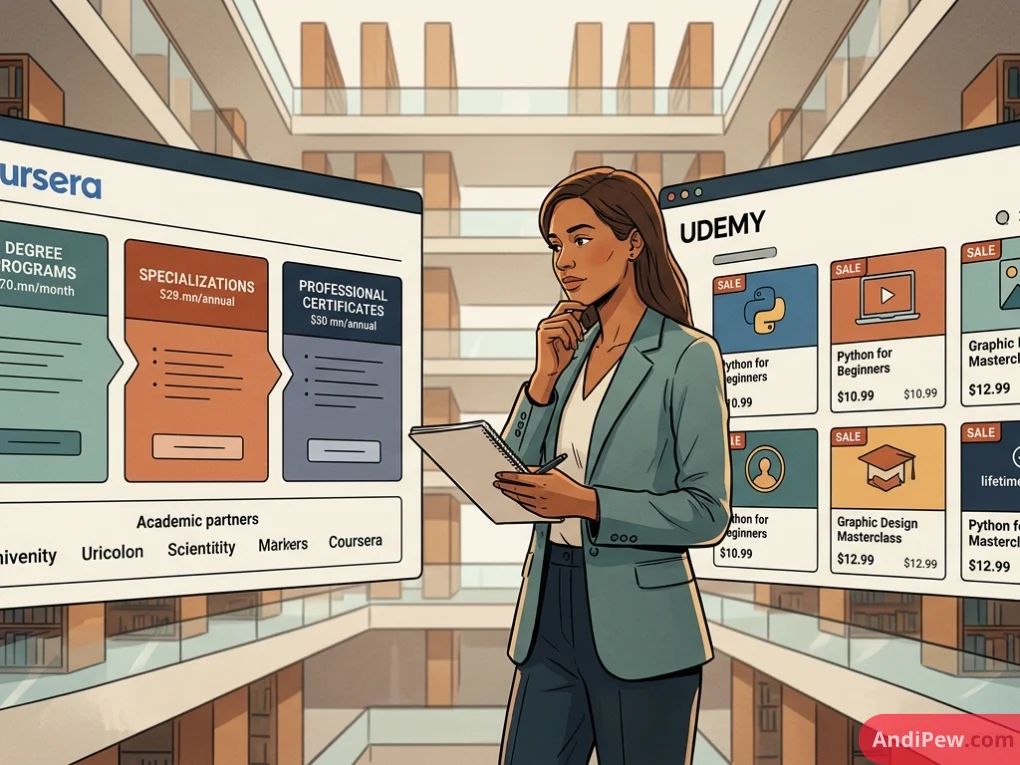
Coursera courses are systematically vetted through formal academic and corporate review boards, whereas Udemy relies on an uncurated marketplace model where course quality, currency, and accuracy depend entirely on individual instructor diligence.
Coursera mandates that content originates from accredited educational institutions (e.g., Yale, University of London) or tier-one tech enterprises (e.g., Google, IBM, AWS). Curricula undergo periodic institutional audits, ensuring factual precision, pedagogy-driven lesson sequencing, and up-to-date documentation.
Udemy allows anyone with an account to upload a video course. While the platform hosts world-class practitioners who release updates alongside framework versions, it also carries thousands of outdated, unmaintained tutorials with obsolete code libraries.
Verification Standards Breakdown
Coursera Pros & Cons
- Strict Quality Floor: All content meets rigorous instructional design standards backed by established organizations.
- Zero Solo Vendor Lock-in: Curricula represent vetted enterprise standards rather than single-person opinions.
- Slower Update Cadence: Enterprise and university audit cycles mean emerging tools take longer to arrive on the platform.
Udemy Pros & Cons
- Instant Market Agility: Independent instructors launch tutorials within days of new framework, library, or AI API releases.
- Buyer Due Diligence Required: Students must verify the “Last Updated” date, preview course audio/video quality, and read recent reviews to avoid obsolete curricula.
- Variable Production Value: Audio quality, microphone clarity, and presentation structures vary wildly from instructor to instructor.

Do Employers Value Coursera or Udemy Certificates in 2026?
Employers and corporate applicant tracking systems (ATS) recognize Coursera Professional Certificates as legitimate entry-level qualifications, whereas Udemy certificates are treated solely as non-accredited indications of personal initiative.
Coursera partners directly with enterprise hiring pipelines through platforms like the Google Career Certificates Employer Consortium. Furthermore, many Coursera programs carry formal American Council on Education (ACE) Credit Recommendations, allowing students to translate certificate completion into transferable undergraduate college credits at partner universities.
Udemy issues unaccredited certificates of completion whenever a user marks all video lessons as watched. Because Udemy exercises no identity verification and features no proctored testing, recruiters assign zero independent weight to the certificate paper itself. To derive career value from a Udemy course, you must translate the curriculum into verifiable public proof:
- Production Code Repositories: Push your customized project code to GitHub with detailed commit histories rather than copying course files verbatim.
- Live System Deployments: Host full-stack web applications on cloud services with public, functional URLs.
- Case Study Documentation: Write technical breakdowns explaining architecture trade-offs, database schemas, and performance optimizations.

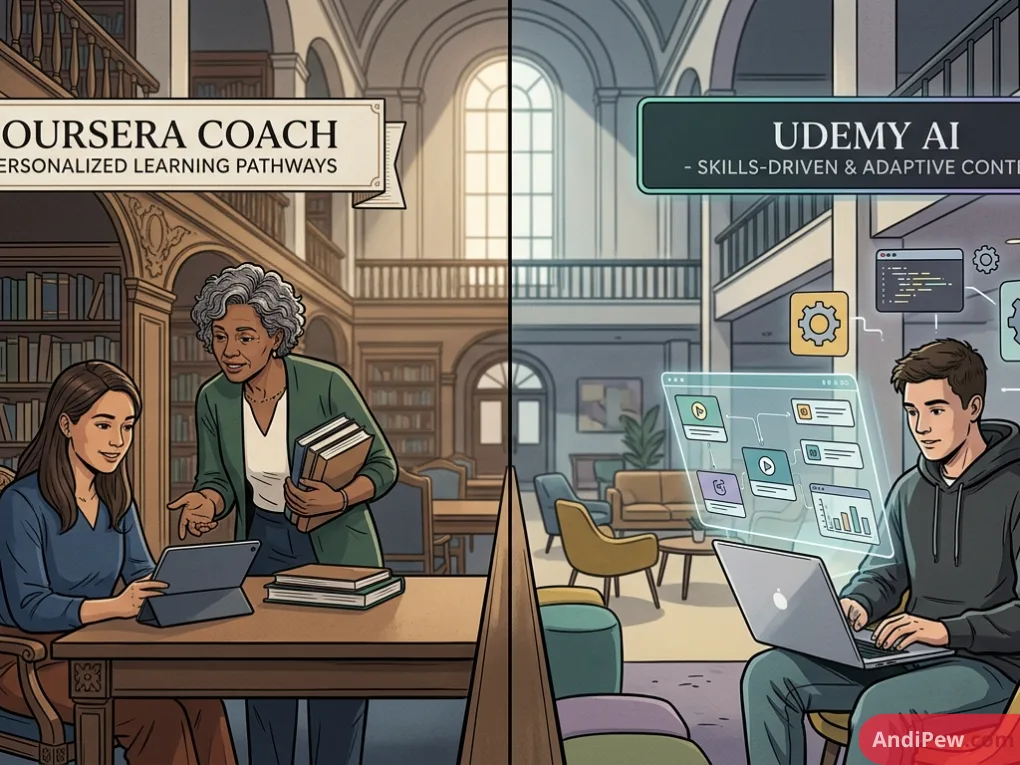
Learning Experience and AI Features: Coursera Coach vs Udemy AI
Coursera features interactive AI coaching grounded strictly inside verified enterprise coursework, while Udemy emphasizes practical development exercises supported by third-party generative Q&A summaries.
Coursera Coach acts as an interactive pedagogical tutor. It evaluates lecture transcripts, reading assignments, and lab rubrics to deliver real-time hints without generating raw answer keys. This preserves academic integrity during graded evaluations.
Udemy deploys automated AI summaries within community discussion boards and lecture video chapters. Its integrated coding environments let learners isolate syntax errors within basic browser-based sandboxes, though real-time pedagogical context remains limited.
- Assessment Rigor: Coursera uses proctored exams, randomized question pools, automated code autograders, and peer-reviewed capstone assignments. Udemy relies almost exclusively on non-proctored, self-graded multiple-choice quizzes and basic optional coding exercises.
- Mobile Learning Performance: Both platforms provide iOS and Android applications supporting full offline video downloads. Coursera integrates downloadable lecture transcripts and reading PDFs; Udemy focuses on audio-only background playback and video speed adjustments (up to 2x).
- Community Responsiveness: Udemy courses with active instructors resolve questions inside community discussion tabs within 24 to 48 hours. Coursera relies primarily on cohort-based peer discussion forums, which can feel inactive within older, low-enrollment university courses.
Which Platform Should You Choose?
Choose Coursera if you need structured career transitions, recognized credentials, and academic depth; choose Udemy if you need rapid tactical upskilling, niche software workflows, and perpetual reference materials at a single flat price.
Step-by-Step Decision Framework
Use this “If/Then” routing guide to determine which platform aligns with your objective:
- If your primary objective is to pivot into a new field (data analytics, cybersecurity, UX design) without a degree: Choose Coursera. Enroll in an enterprise-backed Professional Certificate to build an ATS-recognized portfolio credential.
- If you need to troubleshoot a technical roadblock, learn a specific framework version, or explore a tool over the weekend: Choose Udemy. Wait for a sale, pay $12.99–$19.99, and secure perpetual lifetime access.
- If your employer provides an annual learning budget and values accredited coursework: Choose Coursera Plus ($399/year) to complete multiple Specializations with formal institutional badges.
- If you want to master creative hobbies, game development engines, or niche trading tools not taught in universities: Choose Udemy, as open marketplace instructors fill catalog voids that universities ignore.
Frequently Asked Questions
Is Coursera more respected than Udemy by employers?
Yes, Coursera certificates carry significantly more respect among hiring managers and ATS screeners. Coursera partners directly with accredited universities and industry leaders like Google and IBM. Udemy certificates confirm course completion rather than accredited competence, meaning hiring teams view them primarily as evidence of self-motivation rather than formal qualification.
Can you get a job with just Coursera certificates?
Coursera Professional Certificates can help you land entry-level roles in fields like IT support, data analysis, and UX design. While a certificate alone rarely guarantees employment, completing capstone projects and passing ACE-accredited assessments provides a credible, verifiable portfolio that satisfies entry-level recruiter benchmarks.
Is Udemy really lifetime access?
Yes, purchasing an individual course on Udemy grants lifetime access to that content, including future instructor updates. This access applies as long as Udemy maintains the platform license and your account remains in good standing. Note that Udemy’s Personal Plan subscription only retains access during an active billing cycle.
Does Coursera still offer free courses?
Coursera allows learners to audit thousands of individual courses completely free of charge. The free audit track gives full access to lecture videos and reading materials. However, graded assignments, peer-reviewed assessments, and shareable completion certificates remain locked behind a course fee or a Financial Aid application.
Can Coursera courses count for real college credits?
Selected Coursera programs offer legitimate college credits through ACE (American Council on Education) credit recommendations. Learners who complete recognized MicroBachelors, MicroMasters, or Google Professional Certificates can transfer those credentials into degree programs at participating partner universities worldwide.
Is Udemy better for programming than Coursera?
Udemy is often better for mastering specific coding libraries, niche frameworks, and practical troubleshooting workflows quickly. Instructors update practical project tutorials rapidly when new framework versions launch. Conversely, Coursera is superior for foundational computer science, algorithm design, and structured software engineering principles.
Coursera excels in structured academic rigor, employer-recognized credentials, and formal university partnerships designed for career transitions. Udemy delivers unbeatable value for targeted, self-paced tactical skills, offering lifetime access to specialized software tutorials at bargain prices. Your decision comes down to credentials versus tactical execution: invest in Coursera for career-defining resumes, or grab an individual Udemy course to solve an immediate technical challenge today.
Assess your immediate learning goal, verify your available study hours per week, and audit your target course for free before committing your budget.
Explore more information and other interesting articles: